In House vs Video Production Agency: Which Is Right for Your B2B Team?


In House vs Video Production Agency: Which Is Right for Your B2B Team?
The choice between in house vs video production agency depends on the volume, complexity, and business importance of the videos you need. An in-house team is often the better choice for frequent, repeatable content that requires speed and close product knowledge. An agency is usually stronger for high-stakes campaigns, specialist creative work, complex production, or periods when your internal team lacks capacity.
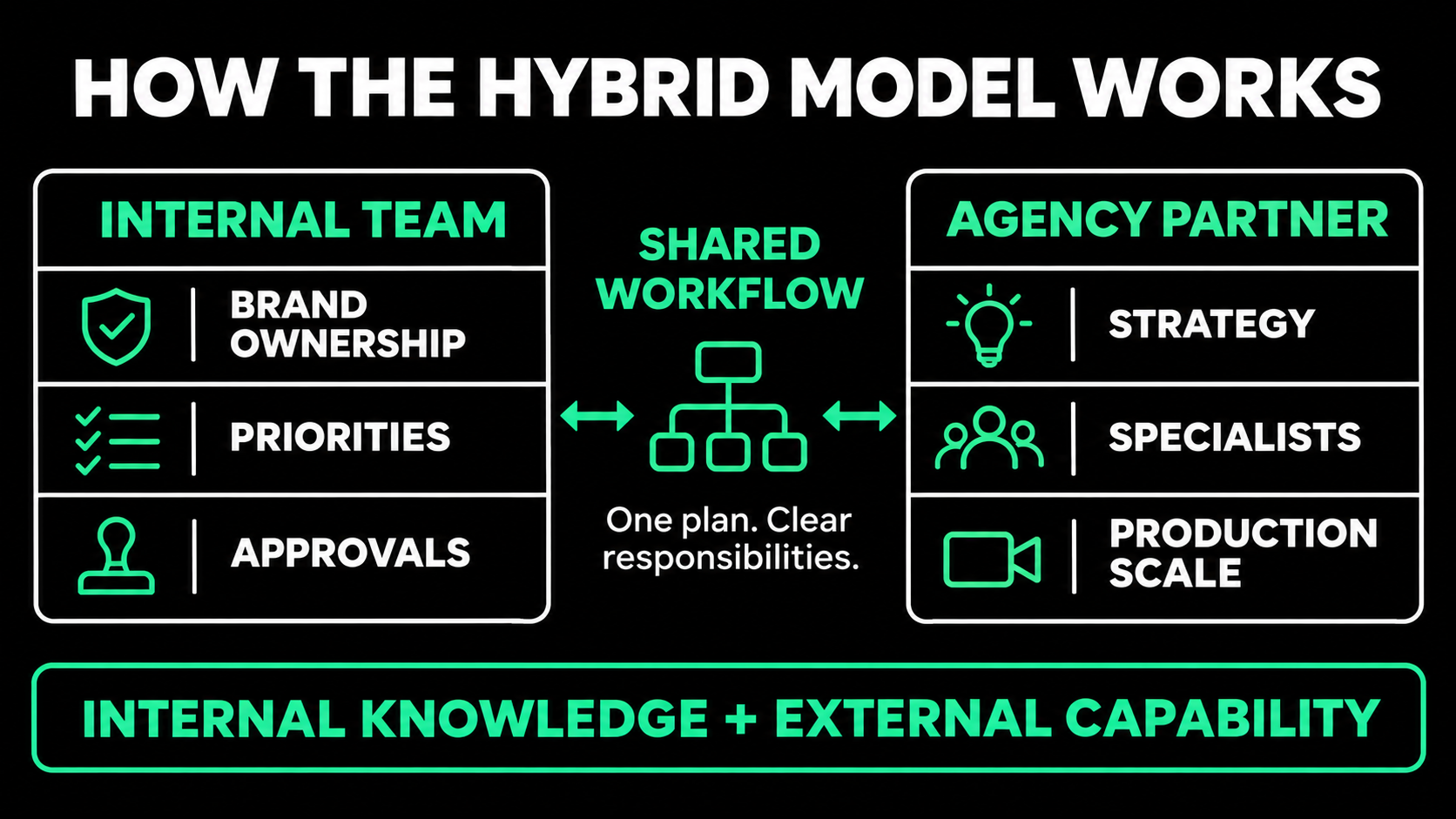
For many B2B companies, the best answer is a hybrid model. Internal marketers own the strategy, subject expertise, and ongoing content, while an agency supports major campaigns, advanced production, or defined gaps in capability.
The decision should not be based on whether internal or external work is always cheaper. Compare the complete system required to plan, produce, approve, distribute, repurpose, and measure useful video.
Start With the Work, Not the Team Structure
Before deciding who should produce the videos, define what the business needs video to accomplish. A team publishing weekly product updates has a different requirement from a company producing three important campaign videos each year.
List the likely projects for the next 12 months across product marketing, demand generation, sales, customer education, events, and social content. Estimate each project's frequency, complexity, shelf life, distribution, and business risk.
A short customer screen recording may need product knowledge and a fast turnaround. A multi-location customer story requires strategy, interviewing, production, permissions, and several deliverables. They are different resourcing problems.
Wistia's 2026 State of Video research found that blended teams are becoming common. In-house production is growing while companies continue using freelancers and agencies, reflecting how varied video needs can be.
What In-House Video Production Does Well
In-house video production places the people responsible for video inside the company. The team may include a dedicated producer or editor, or it may be part of a broader content and brand function.
Its greatest advantage is proximity. Internal creators learn the product, customers, approval process, and brand language. They can notice emerging stories and respond quickly when priorities change.
This model works well for regular content such as:
- Product updates and screen recordings
- Social videos and executive commentary
- Webinar and event edits
- Internal communications
- Customer education and onboarding
- Simple sales enablement clips
Internal teams also control scheduling and iteration. Recurring formats become faster once templates and workflows are established.
The tradeoff is that one or two hires cannot master every discipline. Strategy, interviewing, cinematography, sound, animation, editing, and distribution require different capabilities. A strong editor may not be the right customer interviewer or animation lead.
Capacity is another constraint. Without priorities and an intake process, high-value projects compete with urgent requests from every department.

What a Video Production Agency Does Well
A video production agency provides a broader team without permanent specialist hires. Depending on scope, it may include strategists, writers, producers, crews, animators, editors, and project managers.
Agencies are valuable when a project requires experience or scale the internal team does not use weekly, such as a product launch, customer story series, complex animation, multi-location shoot, or paid campaign.
An external team can challenge internal assumptions. B2B companies often rely on internal terminology and feature lists. A capable agency can identify what buyers need and translate technical information into a clearer story.
Agencies also bring flexible capacity around launches, events, and campaign deadlines without requiring permanent roles.
The weaknesses are onboarding, access, and coordination. An agency must learn the product, buyers, brand, and approvals. A weak brief or unavailable experts can create extra reviews and slow decisions.
Agency work also needs scope discipline. Changes to the concept, production approach, locations, reviews, or deliverables affect cost and timing.
In-House Video Team vs Agency: A Direct Comparison
The following comparison is a useful starting point, but the right choice depends on the work you mapped earlier.

The right structure delivers suitable quality and output without wasting time or budget.
Compare the Full Cost of Each Option
The cost of an internal team is not one salary. Include recruiting, benefits, management, equipment, software, storage, licenses, training, freelancers, and coverage. The U.S. Bureau of Labor Statistics treats producers, directors, editors, camera operators, and animators as distinct occupations, showing why full production capability rarely sits in one role.
An agency quote may look higher than an employee's project time, but it can include specialists, management, equipment, and delivery. Costs rise when scope expands, feedback is late, or versions were not planned.
Compare annual cost per useful output, not hourly cost. Include the time marketers, experts, legal reviewers, and executives spend guiding the work.
Consider utilization. A full team is efficient with steady demand. If only a few complex videos are needed, specialist hires and equipment may sit underused. Outsourcing video production then converts fixed capability into project cost.

Compare Speed and Capacity Honestly
In-house teams are often faster for familiar work. They can capture an interview, update a product recording, or create a social edit without extensive onboarding.
But access does not guarantee capacity. A producer supporting several departments may have a long queue, while urgent requests interrupt strategic work.
An agency needs onboarding but can assign specialists and protect a schedule. For a complex launch, this may be faster than asking a generalist to learn new techniques alongside normal work.
Ask two separate questions: How quickly can the project start, and how reliably can it finish? The first often favors an internal team. The second may favor the team with dedicated capacity and a clear approval process.
Consider Quality as Fitness for Purpose
Quality does not always mean cinematic production. A direct product update recorded by an internal expert may be more useful than an elaborate film. The standard should match the audience, channel, shelf life, and business objective.
For routine content, consistency, accuracy, and speed may matter most. A homepage video, launch, paid campaign, or customer story may require stronger strategy and execution because more buyers will see it for longer.
Ask whether the team can execute the idea credibly. Complex animation, several locations, talent, or advanced post-production may exceed a limited setup. Hiring a large crew for every product tip also wastes budget.
Decide Who Owns Strategy and Distribution
Production is only one part of video marketing. Someone must define the audience, objective, message, distribution, action, and measurement.
An internal marketing leader should remain accountable for the business case. The company owns customer knowledge, priorities, product truth, and alignment. The agency turns that context into a concept and production plan.
Distribution also needs an owner. Plan how the concept will appear across the website, paid media, social, sales, events, and email. Decide on versions before production so the script and footage support them.
This is one reason the agency-versus-in-house decision should not be reduced to who holds the camera. The more important question is who owns each part of the system.
When Should You Keep Video In-House?
Choose or expand an internal capability when video demand is frequent, formats are repeatable, fast access matters, and there is enough work to keep the team productively occupied.
It fits regular product education, webinars, executive content, social video, internal communication, and sales clips, especially when deep product knowledge matters and the style uses a consistent setup.
Before hiring, decide whether the greatest need is producing, editing, animation, strategy, or operations. An undefined “video person” role creates unrealistic expectations.
When Should You Hire a Video Production Agency?
Hire an agency when the project is strategically important, technically complex, outside the internal team's experience, or too large for current capacity. This can include customer story programs, product launches, brand campaigns, sophisticated explainers, multi-location productions, or a full set of campaign assets.
Should you outsource video production? Yes, when the cost of a weak result, missed deadline, or distracted internal team is greater than the agency fee. Outsourcing is also sensible when you need a capability occasionally and cannot justify maintaining it full time.
Choose a partner based on strategic fit, relevant work, process, scope clarity, and understanding of B2B buyers. Ask how it handles discovery, experts, reviews, distribution versions, rights, files, and performance goals.
When Does a Hybrid Model Work Best?
A hybrid model works when the company needs both consistent output and specialist support. The internal team can own the content calendar, product updates, webinars, quick social assets, and brand governance. The agency can lead major campaigns, complex creative, high-value customer stories, and production surges.
Define who owns the brief, script, expert access, production, feedback, approval, distribution, files, and reporting. Without clear ownership, hybrid work becomes duplicated work.
A useful hybrid relationship transfers knowledge. Templates, interview frameworks, shot libraries, and repurposing plans can improve routine internal content after the main project.
Make the Decision With a Simple Scorecard
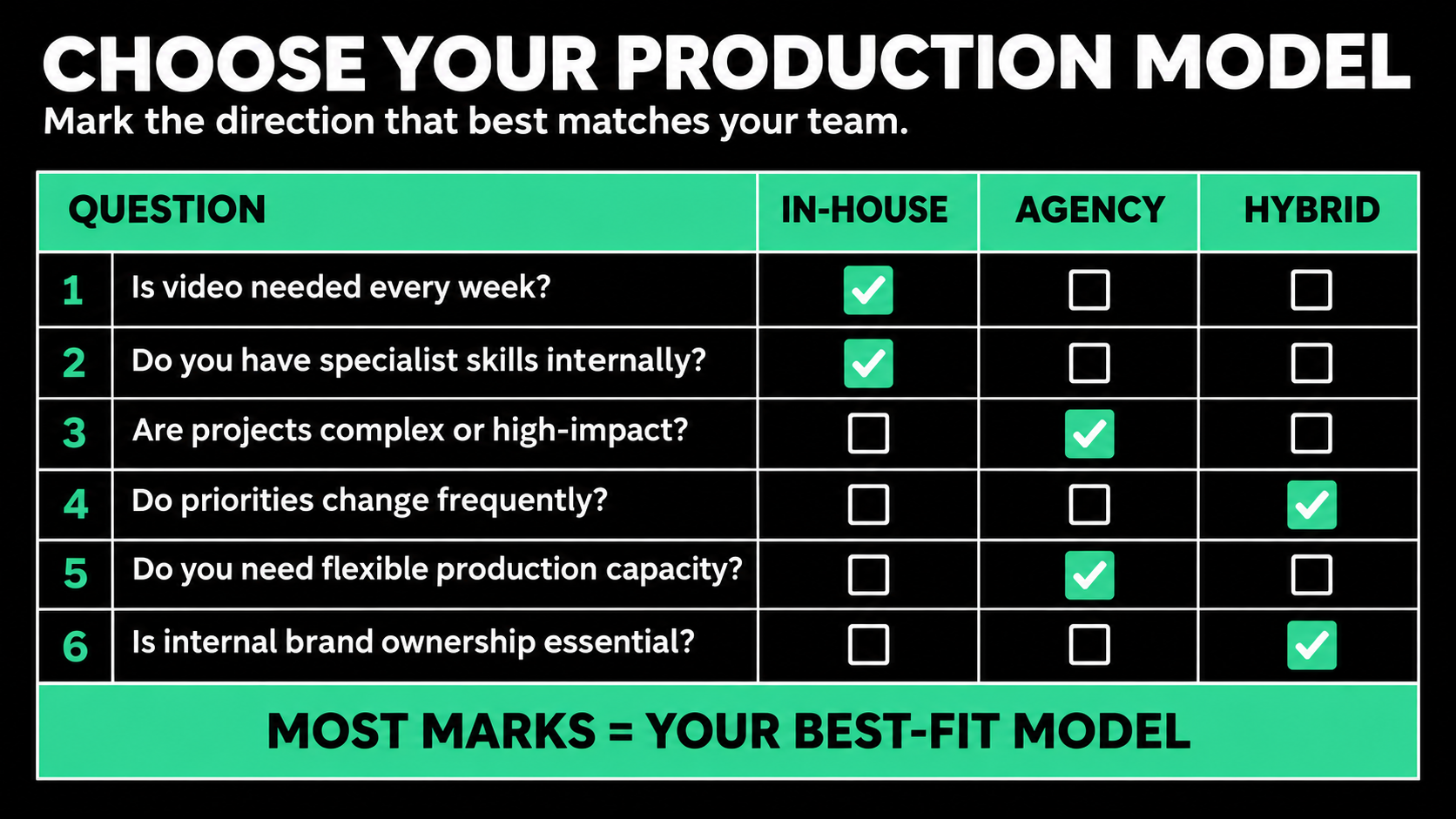
For each planned video, score these questions from low to high:
- How frequently will we produce this format?
- How specialized are the required skills?
- How costly would a weak result or missed deadline be?
- How much internal product access is required?
- Does the internal team have protected capacity?
- How many versions, locations, and stakeholders are involved?
Frequent, repeatable, lower-risk work usually leans in-house. Occasional, specialized, high-visibility work usually leans toward an agency. Projects with strong internal knowledge requirements and complex execution are often best served by a hybrid team.
The answer can change over time. A company may begin with an agency, build an internal function as volume grows, and continue using external specialists for major work.
Choose the Model That Supports the Business Goal
The debate between in-house video team vs agency does not have one universal winner. Internal teams offer proximity, speed, and deep knowledge. Agencies offer specialist skills, scalable capacity, outside perspective, and experience managing complex productions.
Choose based on your planned work, not a general preference for hiring or outsourcing. Account for the full cost, realistic capacity, required quality, approval process, distribution needs, and risk attached to each project.
For many B2B companies, the strongest structure is a focused internal owner supported by an agency when the work requires greater strategy, craft, or scale. That arrangement keeps video connected to the business while giving important campaigns the resources they need.
Not sure whether your next B2B video belongs in-house, with an agency, or across both teams? Spacebar Visuals helps companies define the strategy, scope, production approach, and campaign assets required to make the investment useful.
Book a video strategy call to discuss your goals, internal capabilities, and production needs.
Let’s build your product story together


View Related Resources
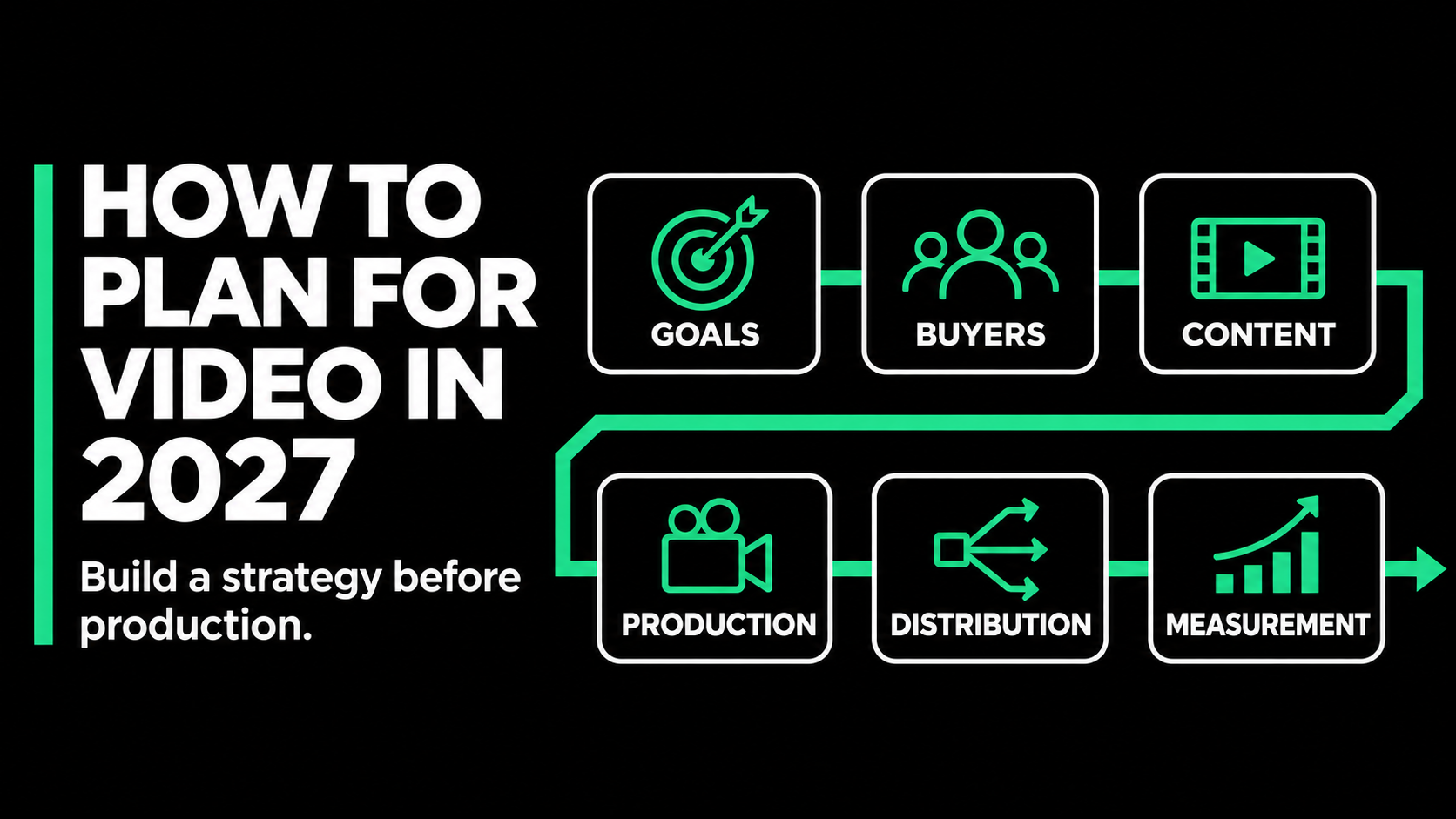
B2B Video Marketing Strategy: How to Plan for 2027

B2B Video Funnel: How to Use Video at Every Stage
