B2B Video Funnel: How to Use Video at Every Stage


B2B Video Funnel: How to Use Video at Every Stage
A B2B video funnel uses different videos to answer the questions buyers have as they move from recognizing a problem to evaluating options, making a decision, and becoming a customer. At the top of the funnel, video should create relevance and make the problem easier to understand. In the middle, it should explain the approach and demonstrate value. Near the decision, it should reduce risk, provide proof, and help the buying group reach agreement.
The strongest strategy does not begin by producing one video for each funnel stage. It begins with the audience, business objective, distribution plan, and action that each video should support. One core concept can then be adapted across paid media, organic social, website pages, email, sales outreach, events, and customer education.
This guide explains how to use video in a B2B sales funnel without creating disconnected assets or measuring every video by the same standard.
Why One Video Cannot Do Every Job
B2B teams often expect one company overview to generate awareness, explain the product, convince technical reviewers, support sales, and onboard customers. That is too much work for one asset.
A buyer who has just discovered a problem does not need a detailed interface tour. A technical evaluator does not need another broad statement about changing the industry. A finance stakeholder may care more about risk, implementation, and financial impact than the product features that first attracted the marketing lead.
B2B decisions are also made by groups whose members bring different priorities and objections. LinkedIn's research notes that video can make a brand's value easier to understand, share, and evaluate across the buying group. That matters because your primary contact often has to explain the decision internally.
A full-funnel B2B video strategy gives buyers the right level of information for the decision in front of them. The videos should feel connected, but they should not repeat the same message in different runtimes.
Start With Buyer Questions, Not Video Formats
Before choosing an explainer, testimonial, demo, or thought-leadership video, map the questions buyers need answered.
At a basic level, the journey looks like this:

This map prevents teams from selecting a format because it is popular rather than because it answers a useful question. A vague testimonial that ignores the buyer's concern will not move the decision forward.
Top of Funnel: Make the Problem Relevant
Top-of-funnel video should help the right people recognize a business problem, opportunity, or change in their market. It does not need to explain the entire product.
Useful formats include educational videos, expert perspectives, problem-focused animation, research commentary, and concise brand stories. Start with the audience's world rather than the company's history.
For example, a cybersecurity provider might create a 30-second video about why traditional access reviews fail when employee roles change frequently. The video can make the risk concrete without presenting every feature in the platform. Its next action might lead to a deeper article, assessment, or webinar rather than directly asking every viewer to book a demo.
Distribution is part of the strategy. Paid social can reach defined roles, while organic content builds familiarity through expert voices. Events, partners, and industry publications provide other credible contexts. Use captions and a visual opening because viewers may encounter the content without sound.
Measure awareness through qualified reach, attention, site visits, and engagement from priority accounts. Views alone do not show whether the video reached potential customers.

Middle of Funnel: Explain the Approach
Once buyers understand the problem, they need help comparing possible solutions. This is where the B2B video marketing funnel should become more educational and specific.
Product overviews, use-case explainers, webinars, interviews, comparisons, and animated process stories can clarify the approach. Connect the solution to a recognizable workflow instead of listing every capability.
For a finance automation platform, one use-case video could show how teams handle invoice exceptions across locations. Another could focus on approval visibility for controllers. Both come from the same product story but serve different viewers.
Show enough of the process to make the promise credible. Real screens support workflow accuracy, while animation can clarify integrations or data movement. A hybrid can combine conceptual clarity with product evidence.
Place these videos on solution pages, resource hubs, nurture emails, retargeting campaigns, and webinar follow-ups. Invite viewers to see a demo, review proof, download a guide, or discuss their use case.
Measure whether buyers deepen engagement through completion, return visits, demo-page activity, lead quality, and progression into evaluation.
Evaluation: Show Fit, Workflow, and Proof
During evaluation, buyers are no longer asking only whether the category is interesting. They want to know whether the solution can work in their environment.
Focused demos, role-specific walkthroughs, integration videos, technical explainers, implementation overviews, and customer stories are useful here. Replace one generic demo with modular videos matched to account questions.
A demo should show a meaningful task and explain why each step matters, not narrate every click. Integration content should clarify what connects, how data moves, and what the buyer must prepare. Customer stories need specific challenges and outcomes.
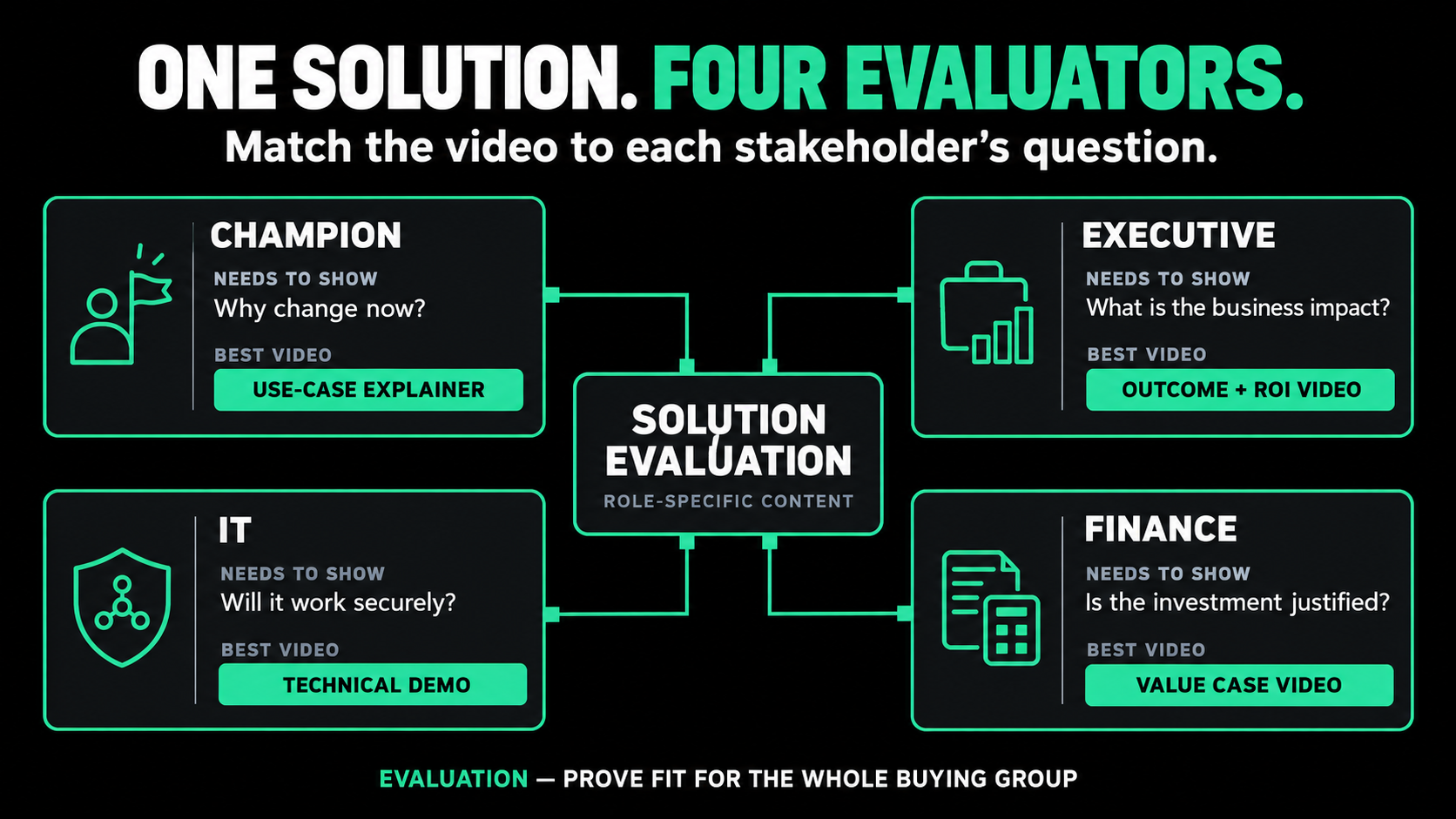
Buying-group coverage matters here. A champion may need a shareable overview, IT a security explanation, an executive a business-value summary, and finance an economic justification.
Video does not replace conversations or documentation. It gives stakeholders a consistent explanation they can revisit and share.
Measure evaluation content through active-opportunity use, stakeholder sharing, account engagement, meetings, and sales-stage movement. A technical video with 40 relevant views may outperform a broad video with thousands of unqualified plays.
Decision Stage: Reduce Risk and Support Consensus
Near a purchase decision, video should increase confidence rather than introduce a new brand story. Buyers need reassurance that the solution is credible, practical to implement, and supported by people who understand their environment.
Useful assets include implementation roadmaps, executive customer stories, security explanations, onboarding previews, and personalized sales recaps. A recording of the buyer's objectives and next steps can keep a complex opportunity aligned.
Proof must be supportable. Use approved customer results, real workflows, credentials, expert explanations, and clear boundaries. Avoid vague superlatives and do not imply capabilities that the product does not have.
The action should match the opportunity, such as confirming requirements, arranging an executive discussion, reviewing implementation, or moving to a proposal. Relevance matters more than public reach.
Customer Stage: Improve Adoption, Retention, and Growth
The video sales funnel should not end when the contract is signed. Customer video can help users reach value faster and give account teams a clearer way to introduce new capabilities.
Create onboarding modules around key milestones. Use feature videos, role-based walkthroughs, webinar chapters, and best-practice stories. Keep the library searchable and current.
Expansion video should begin with a customer need, not an upsell. Show how another team or feature addresses a related problem. Customer advocates may later contribute to testimonials, events, and peer education.
Measure adoption, training completion, feature use, support demand, customer engagement, renewal influence, and expansion opportunities. Customer education may have modest public view counts while creating significant operational value.
Connect Marketing and Sales Distribution
A strong B2B funnel strategy can still fail if nobody knows when or where to use the videos. Marketing should not simply upload the final files and send sales a folder link.
For each asset, document the audience, stage, problem, channels, action, and restrictions. A name such as “IT Security Review | Identity Platform | 2 Minutes” is more useful than “Final-video-v7.”
Build videos into nurture programs, landing pages, account campaigns, sales sequences, events, and onboarding. Make each asset easy to find by use case or objection.
Let sales feedback shape the roadmap. Repeated questions, stalled opportunities, and common objections signal what to create next. Marketing can produce one reusable answer instead of leaving every representative to explain it differently.
Repurpose Strong Concepts Across the Funnel
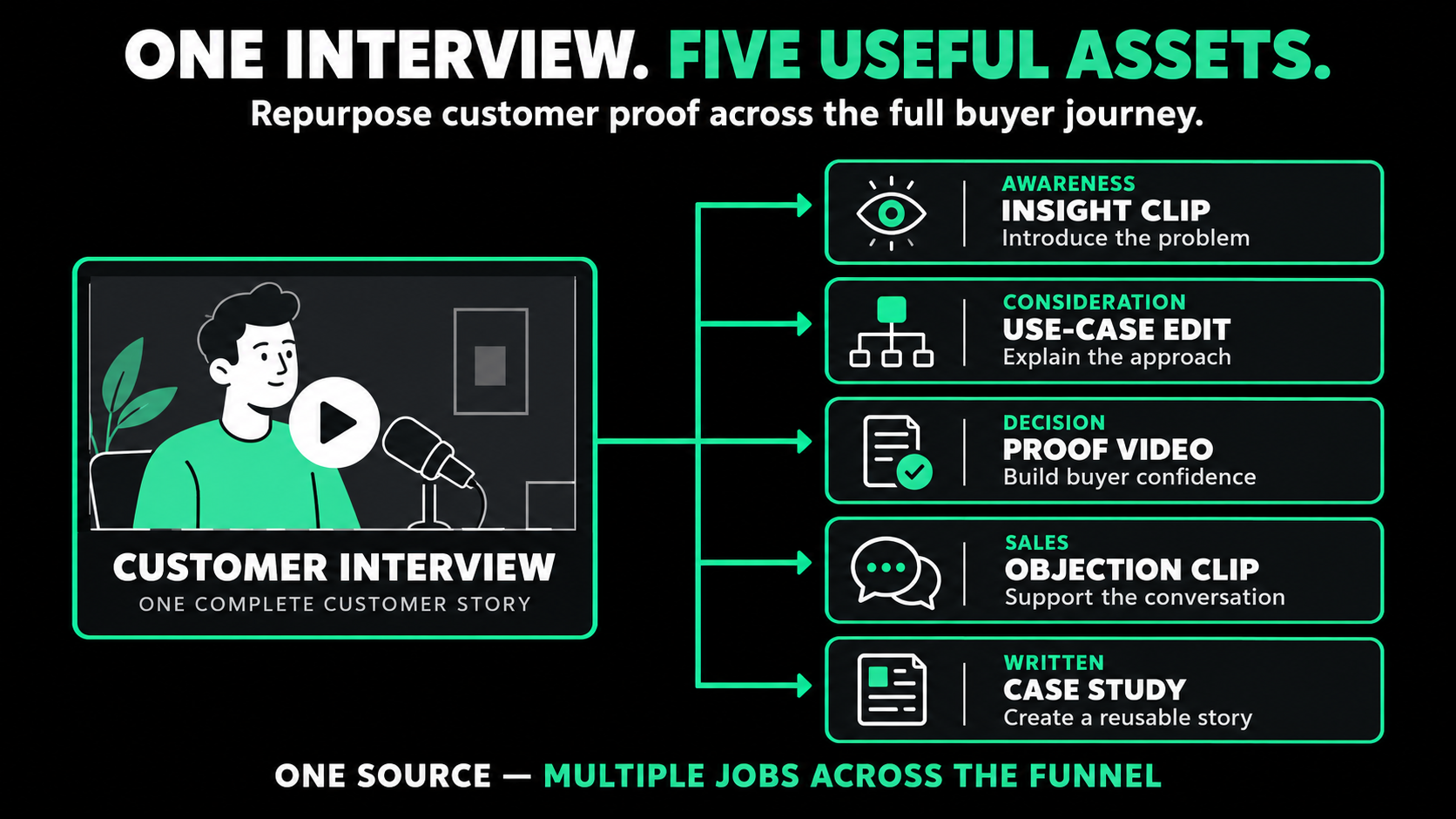
Full-funnel planning does not require a separate shoot for every asset. One customer interview can produce a complete story, awareness clips about the original problem, consideration clips about the selection process, decision-stage proof, sales presentation segments, quote graphics, and written case-study material.
A product overview can become a paid edit, use-case videos, a sales clip, silent event content, email GIFs, and campaign stills. Plan these versions before production so the script, framing, and supporting footage make them possible.
Repurposing should adapt the message, not merely shorten the file. A top-of-funnel clip needs a self-contained hook. A decision-stage edit needs specific proof. An event version must work without audio. Each asset should have its own purpose even when it shares footage with the main video.
Measure the Funnel as a Connected System
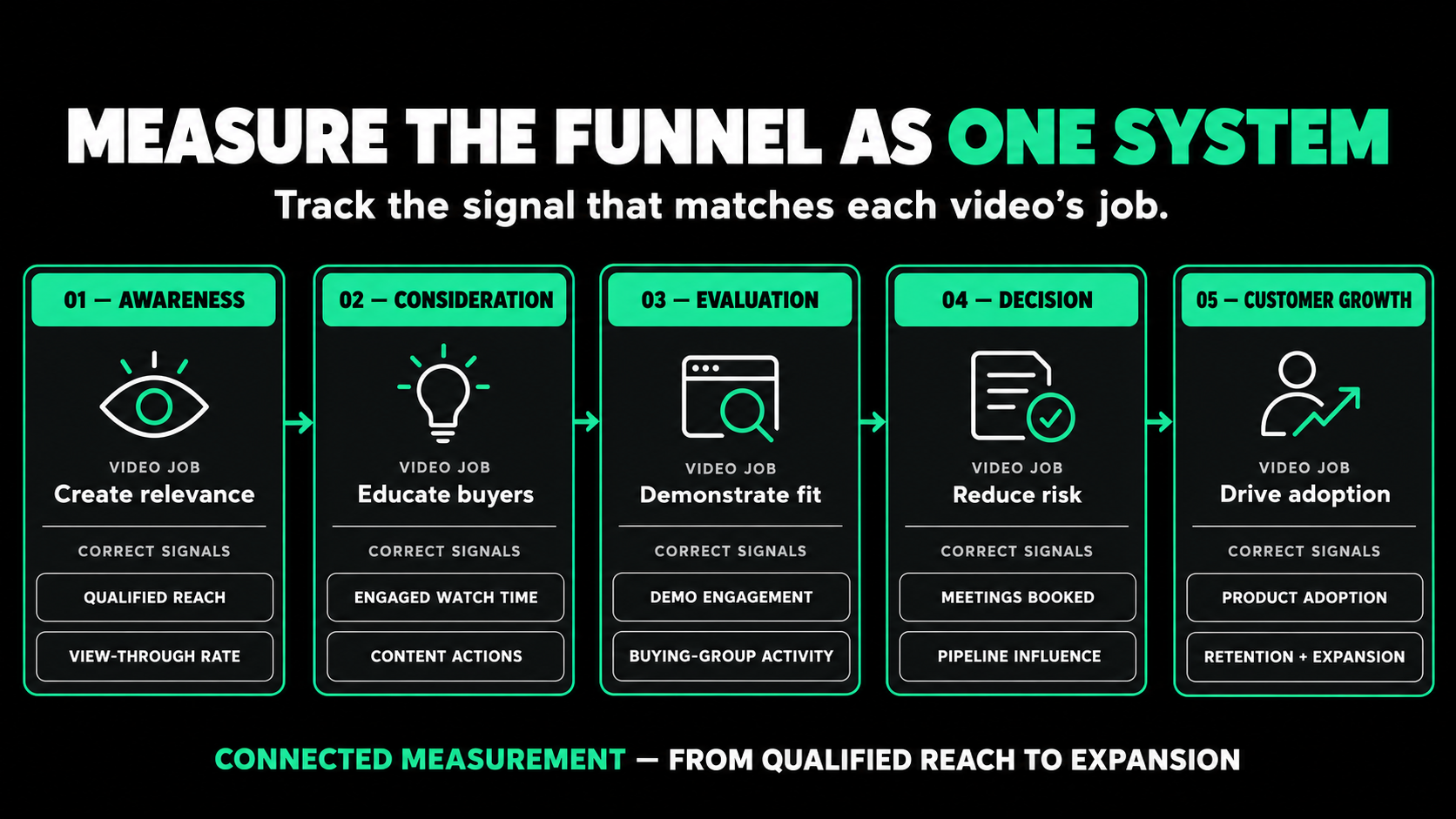
Do not force one metric across every stage. Awareness videos should not be judged only by demo requests, and sales videos should not be judged by public view count.
Before launch, define stage-specific measures: qualified attention, deeper engagement, opportunity progression, and customer adoption or expansion.
Connect video analytics, website data, campaigns, automation, and CRM activity. Attribution will not perfectly describe a long sale, but the combined view shows which videos reach the right accounts and support useful actions.
Wistia's 2026 State of Video research analyzed more than 13 million videos and 79 million hours of viewing data. Its findings reinforce a useful planning principle: video length, format, and placement should follow the viewer's intent. That is more helpful than treating one runtime or completion benchmark as universal.
Add qualitative evidence. Ask sales which videos they send, what buyers mention, and where content is missing. A technical video may deserve a larger role even if its traffic is limited.
Build the Funnel Around Buyer Progress
The purpose of a B2B video funnel is not to fill every stage with content. It is to help buyers make progress.
Start with the questions each audience must answer. Use awareness video to create relevance, middle-funnel video to explain the approach, evaluation content to demonstrate fit, decision assets to reduce risk, and customer video to support adoption and growth.
Connect those assets through distribution, sales workflows, repurposing, and stage-specific measurement. The result is not merely a collection of polished videos. It is a practical communication system that helps a buying group understand, evaluate, and act.
Need a video plan that supports more than one campaign or funnel stage? Spacebar Visuals helps B2B teams connect strategy, production, distribution, and repurposing to the questions buyers need answered.
Book a video strategy call to discuss your audience, funnel gaps, and production priorities.
Let’s build your product story together


View Related Resources
8 B2B Customer Testimonial Video Examples That Work
How to Create a B2B Customer Testimonial Video
