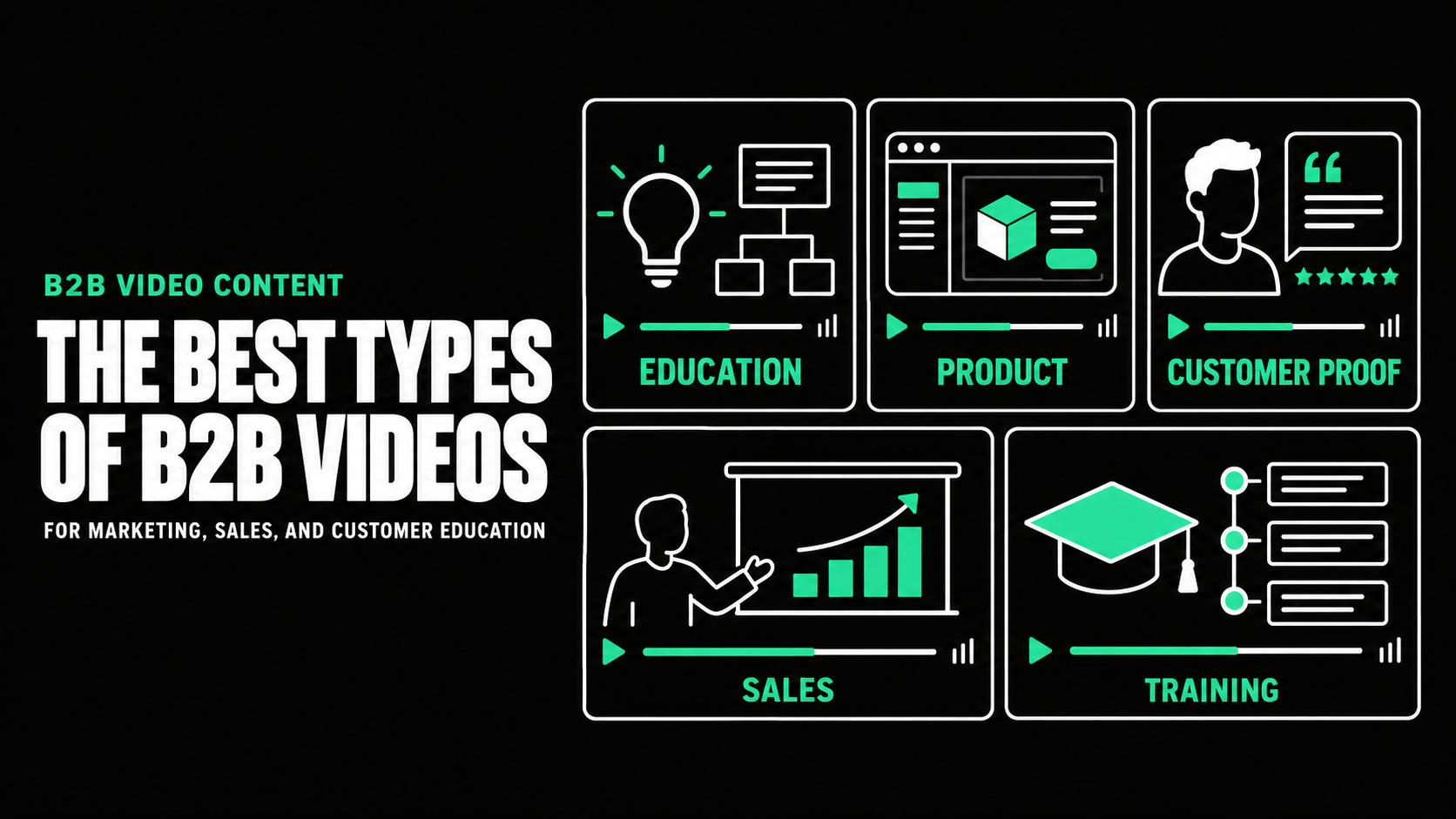
How to Build a B2B Video Marketing Strategy That Drives Results

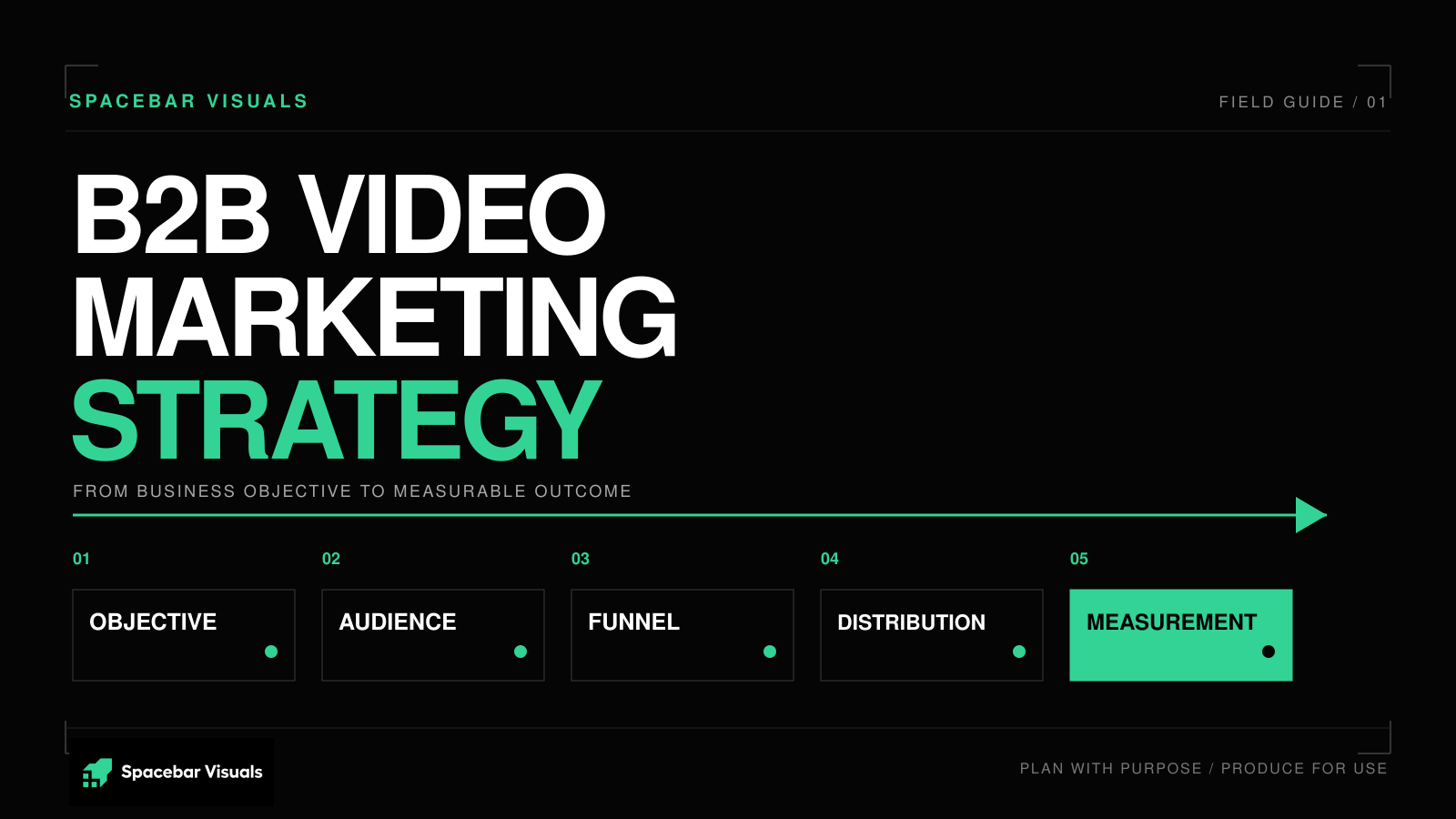
How to Build a B2B Video Marketing Strategy That Drives Results
A B2B video marketing strategy is a plan that connects every video you create to a business objective, a specific audience, a stage of the buyer journey, a distribution channel, and a measurable next step.
Many companies start in the wrong place. They decide they need “a video,” brainstorm what it should look like, and begin production. Only later do they ask where it will live or how it will support revenue.
The result may look polished but still fail to generate meaningful business value.
A strong strategy reverses that order. It begins with the problem the business needs to solve. Then it determines whether video is the right format, which story will move the audience forward, and how the content will reach them.
This guide explains how to build a practical strategy that supports demand generation, product marketing, sales, customer education, events, and brand awareness.
1. Start with the business objective
The first question is not “What video should we make?” It is “What should change after the right person watches it?”
Your answer should describe a business or buyer outcome. For example:
- Increase qualified demo requests from a product page
- Help sales representatives explain a technical product consistently
- Give prospects enough confidence to bring another stakeholder into the conversation
- Improve adoption of an underused product feature
- Create awareness before an industry event
- Turn customer proof into content that supports late stage deals
Avoid broad goals such as “increase engagement” or “build awareness” unless you define what those outcomes mean. Awareness could mean reaching a new audience, increasing branded search, earning more visits from target accounts, or improving recognition within a narrow category. Each version requires a different video marketing plan.
Choose one primary objective for each video concept. A video can support several uses, but it needs a clear main job. When a single piece tries to introduce the company, explain every product feature, share the brand story, and close the sale, it usually does none of those jobs well.
2. Define the audience more precisely than a job title
“Marketing leaders” is not a useful audience definition on its own.
A demand generation director evaluating software has different questions from a chief financial officer approving the purchase. The end user may care about speed and ease of use. The executive sponsor may care about risk, cost, and implementation. Procurement may care about security and contract terms.
For each priority audience, document:
- Their role in the buying process
- The problem they want to solve
- What they already understand
- The objections or risks holding them back
- The evidence they need to move forward
- The action they should take after watching
This exercise affects the script, level of detail, tone, visuals, and call to action.
For example, a 60 second product overview for an executive buyer should focus on the business problem, the product's role, and the outcome. A product demo for an active evaluator should show the workflow in enough detail to answer practical questions. Using the same video for both audiences often leaves one group confused and the other unconvinced.
3. Map video to the B2B buyer journey
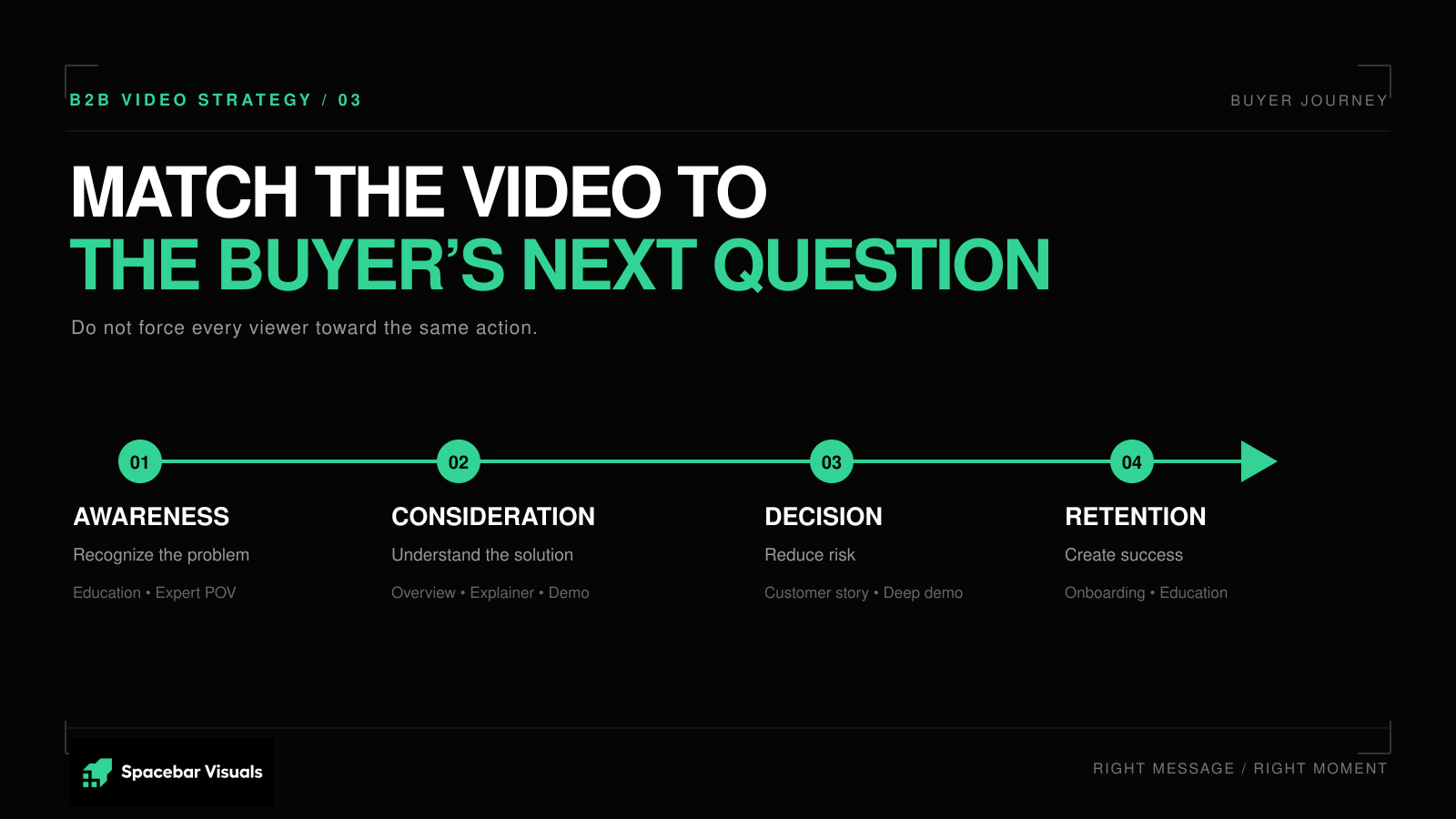
A useful B2B video funnel gives buyers the right information for their current stage and creates a logical next step.
Awareness: Help buyers recognize the problem
At the top of the funnel, your audience may not know your company or may not be actively comparing vendors. Effective formats include educational videos, short expert commentary, category explainers, event content, and problem focused social videos.
The goal is not to explain your full product. It is to earn attention from the right audience by helping them understand an important problem or opportunity.
Consideration: Show how your solution works
Buyers in the middle of the funnel want to understand your approach and determine whether your solution belongs on their shortlist. Product overview videos, animated explainers, use case videos, webinars, and short demos work well here.
This content should answer questions such as:
- What does the product do?
- Who is it for?
- How does it fit into the buyer's current workflow?
- Why is this approach different?
- What would implementation or adoption involve?
Decision: Reduce risk and build confidence
Late stage buyers need proof. Customer stories, detailed product demonstrations, implementation videos, security explainers, and personalized sales videos can help multiple stakeholders reach agreement.
A strong customer story should not be a string of compliments. It should explain the customer's situation, why the problem mattered, how they evaluated the solution, what changed, and who benefited.
Retention and expansion: Help customers succeed
Video marketing for B2B should not stop when a contract is signed. Onboarding videos, feature tutorials, release announcements, best practice content, and customer webinars can improve adoption and introduce expansion opportunities.
Start by identifying the largest content gaps across this journey. You may discover that you have plenty of awareness content but nothing that helps an interested buyer understand the product. In that case, producing more social clips should not be the priority.
4. Choose the right video type for the job
Video types are tools, not a strategy. Choose the format after you understand the objective, audience, and buying stage.
Here are several common B2B needs and the formats best suited to them:
Business needRecommended video typeWhy it worksExplain the company quicklyBrand or company overviewEstablishes the problem, positioning, and value in a concise storyMake a technical product understandableAnimated explainerUses visual metaphors and controlled pacing to simplify complexityShow the product experienceProduct demo or feature videoLets buyers see the workflow rather than rely on claimsBuild trust with evaluatorsCustomer storyProvides evidence through a buyer's real experienceSupport outbound salesPersonalized or use case videoConnects the solution to a specific role, industry, or account problemExtend an event investmentEvent campaign contentSupports promotion, in room engagement, interviews, and follow upImprove customer adoptionEducational or onboarding videoShows customers how to complete a task or use a feature successfully
Our opinion is simple: most B2B companies should build their initial video strategy around a few high value, reusable concepts rather than a high volume of disconnected content.
A clear product overview, a focused demo, and one credible customer story will often do more commercial work than a large batch of generic social videos.
5. Plan distribution before production begins
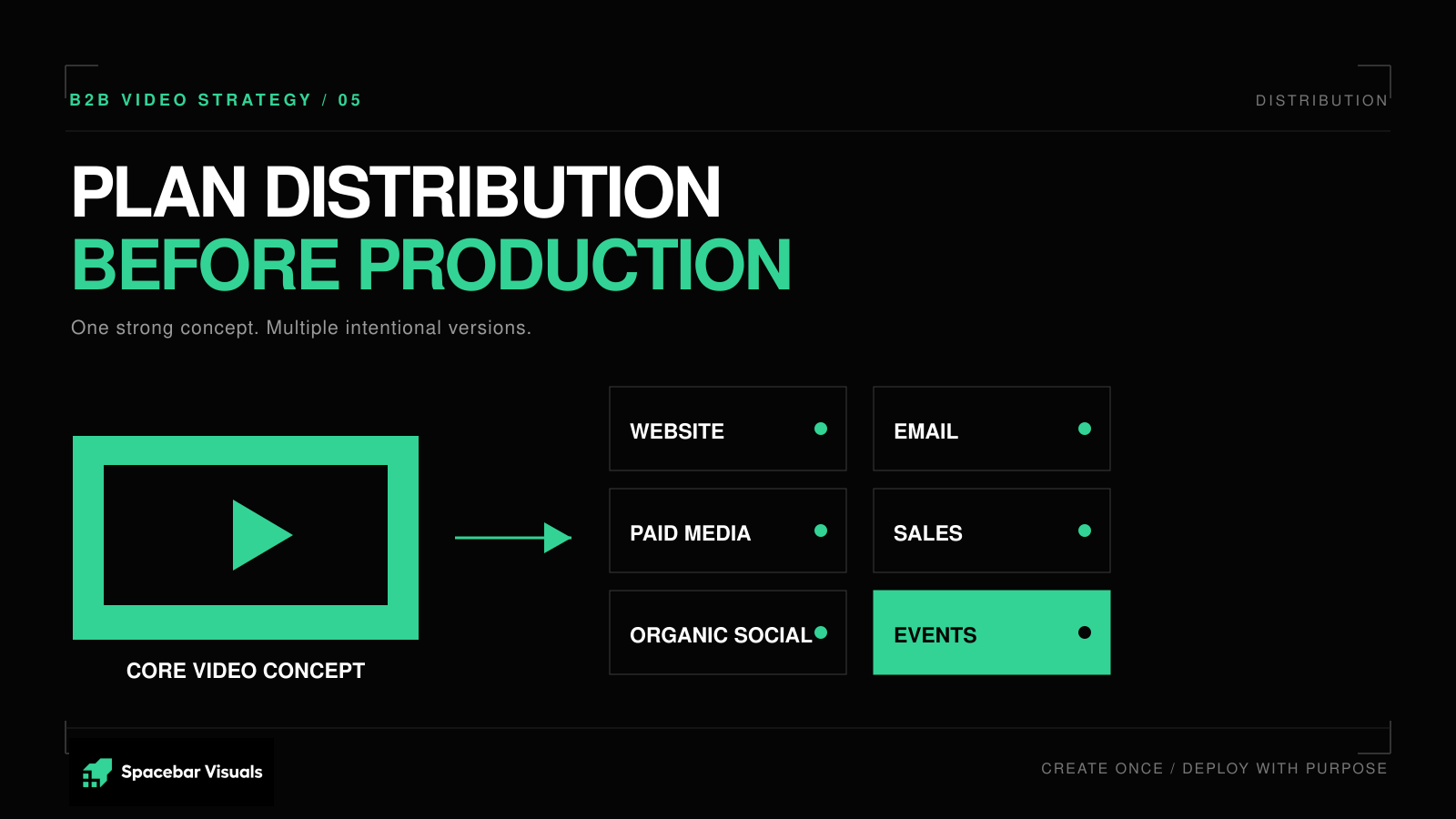
Distribution is part of the creative brief, not a task to figure out after the final export.
A video designed for a homepage must establish context quickly and work for viewers who arrive with different levels of knowledge. A paid social ad needs to earn attention within the opening seconds and make sense without sound. A video used by a salesperson may need a short setup and a direct connection to a common objection.
Before production, list every planned channel:
- Website pages
- Paid social and retargeting campaigns
- Organic LinkedIn posts
- Email and newsletter campaigns
- Sales outreach and follow up
- Sales presentations
- Webinars and virtual events
- Trade show screens and presentations
- Customer onboarding or help centers
Then define the required aspect ratios, durations, opening hooks, captions, calls to action, and versions.
For example, a two minute customer story may be the primary asset. The production plan could also include a 30 second website edit, three vertical clips for LinkedIn, short quote based ads, a silent event version, and selected clips for sales presentations.
That is not simply “cutting up” a finished video. The interview questions, framing, shot list, and edit structure should be planned from the start so every version feels intentional.
6. Build a realistic production plan
A B2B video marketing plan needs clear ownership and enough time for stakeholder review. Many production delays are not caused by filming or editing. They come from unclear feedback, unavailable subject matter experts, and late changes to the core message.
Create a brief before writing the script. It should include:
- Primary objective
- Target audience
- Buyer journey stage
- Core message
- Supporting points or proof
- Desired viewer action
- Distribution channels
- Deliverables and versions
- Brand and visual requirements
- Required reviewers
- Deadline and launch dependencies
Assign one person to consolidate feedback. B2B videos often involve product marketing, brand, demand generation, sales, legal, and executive leadership. If every stakeholder sends separate comments, the team can spend days resolving contradictions.
Agree on what each review stage is for. The script review should resolve the message. The storyboard review should resolve the visual plan. The animation or edit review should focus on execution. Rewriting the strategy after animation begins is expensive and can weaken the final piece.
If internal production capacity is limited, decide what the team should own and where outside support would help. Your subject matter experts should provide product knowledge, customer context, and brand direction. A specialized partner can lead strategy, scripting, production, animation, editing, and versioning while keeping internal reviewers focused on decisions only they can make.
7. Create a system for repurposing video
Repurposing should increase the usefulness of a strong idea, not produce filler.
Begin with a core story that addresses a meaningful buyer question. Then adapt it to the context of each channel.
Imagine a cybersecurity company records a customer interview about shortening its vendor review process. That single production could support:
- A two minute customer story for the website
- A 30 second proof focused paid ad
- Three short clips addressing different buyer objections
- A quote and video clip for an email campaign
- A segment for a sales presentation
- A written case study using the same interview
- A silent loop for an event booth
The central idea stays consistent, but the opening, length, context, and call to action change.
This approach creates message consistency across channels and makes the production investment work harder. It also reduces the pressure to invent a new concept every week.
8. Measure performance based on the video's role
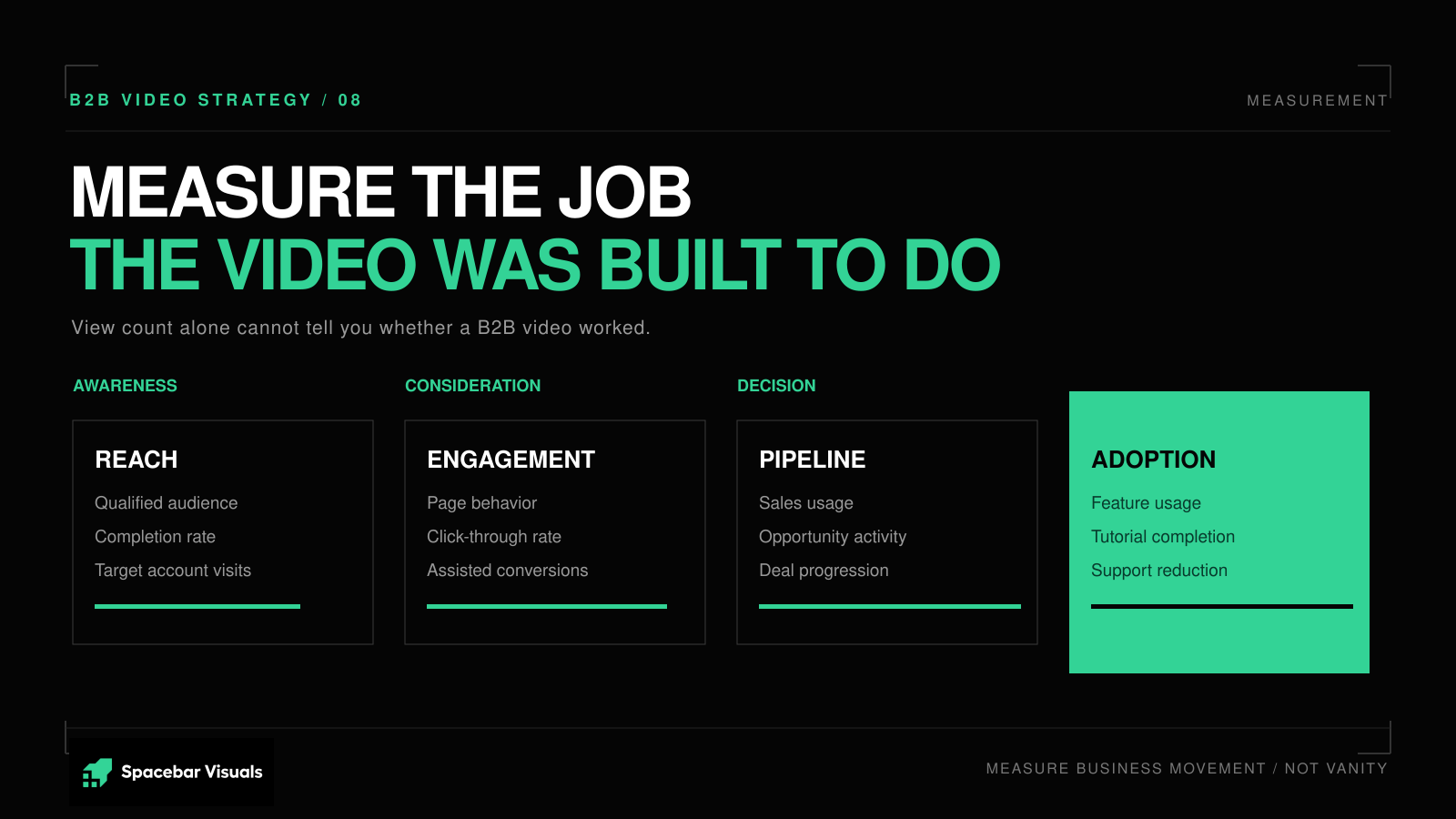
There is no single metric that proves whether every B2B video worked. Measurement should match the objective and distribution channel.
For awareness content, useful indicators may include qualified reach, video completion, engagement from target accounts, branded search, and relevant website visits.
For consideration content, look at product page engagement, click through rate, webinar registrations, repeat visits, and content assisted conversions.
For decision stage content, track whether sales uses the asset, which opportunities engage with it, influenced pipeline, demo requests, deal progression, and recurring objections.
For customer education, measure tutorial completion, product adoption, support ticket reduction, feature usage, and expansion signals.
Be careful with view count. Ten thousand views from the wrong audience may be less valuable than 100 views from active buyers at named accounts.
Also separate the performance of the creative from the performance of distribution. A strong video cannot overcome weak targeting, a low traffic webpage, or a sales team that does not use the asset. If the video is not reaching the intended audience, revise the distribution plan before concluding that the concept failed.
9. Review the strategy as a portfolio
Individual video performance matters, but B2B marketers should also review their video library as a connected system.
Once a quarter, ask:
- Which buyer stages have strong coverage?
- Which priority audiences are underserved?
- What questions does sales answer repeatedly without a useful asset?
- Which videos are outdated because the product or positioning changed?
- Which core assets could be repurposed further?
- Which content is being used consistently by marketing and sales?
This review helps you prioritize the next production based on actual gaps rather than internal requests or passing content trends.
A simple B2B video strategy framework
Before approving a video, your team should be able to complete this sentence:
We are creating [video type] for [specific audience] to help them [desired change] during [buyer stage]. We will distribute it through [channels], ask viewers to [next action], and evaluate it using [metrics].
If the sentence is difficult to complete, the concept is not ready for production.
The best B2B video content strategy is not the one with the largest budget or the most videos. It gives the right buyers useful information, supports a defined objective, and has a realistic plan for distribution and measurement.
Start with the most important gap in your buyer journey. Create one strong concept around it. Plan every useful version before production. Then make sure marketing, sales, and customer teams know where and how to use it.
That is how video becomes part of your growth system instead of another asset sitting in a folder.
Let’s build your product story together


View Related Resources