B2B Video Marketing: What to Create at Every Funnel Stage

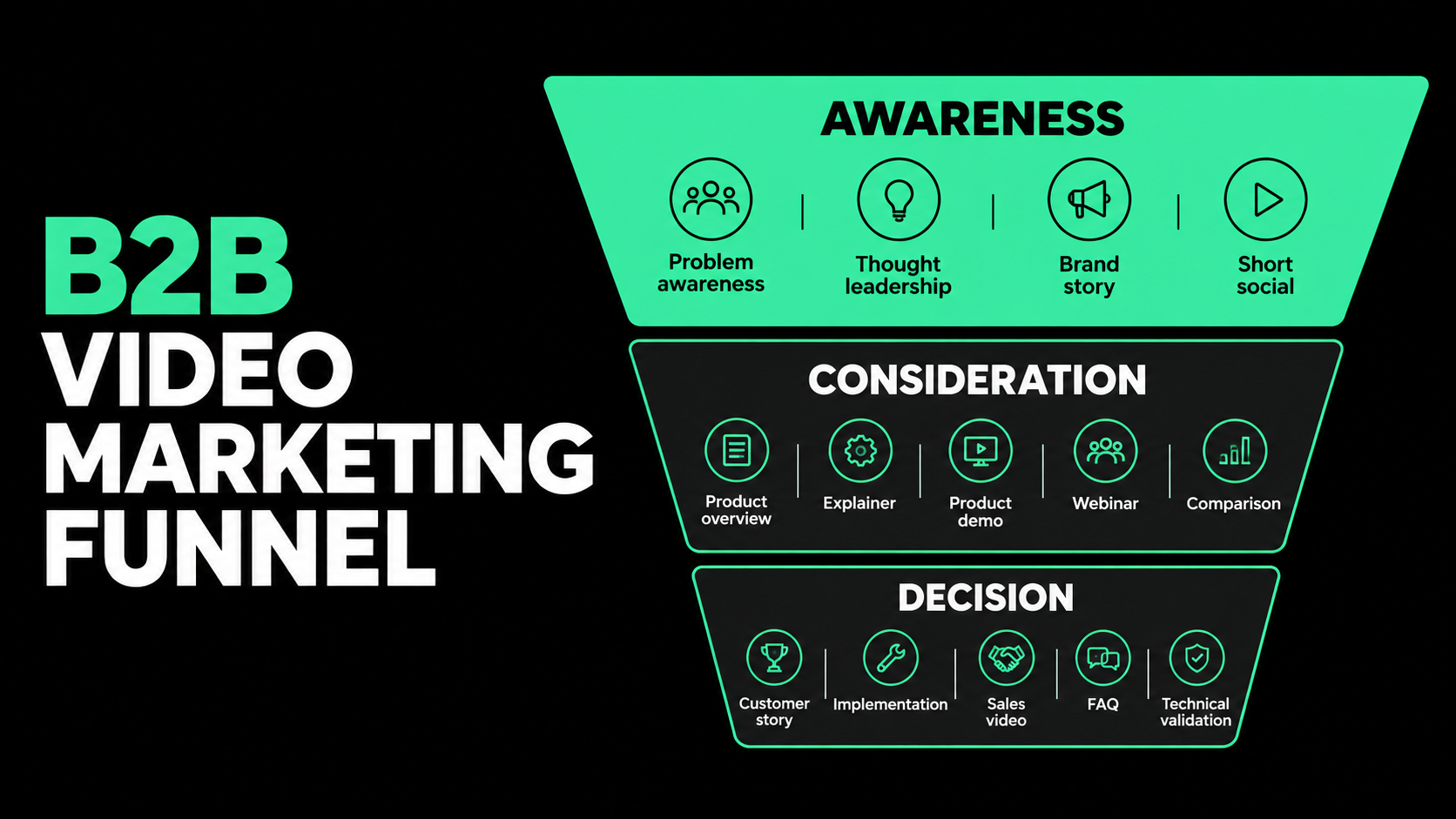
B2B Video Marketing: What to Create at Every Funnel Stage
A strong B2B video marketing strategy does not start by asking, “What video should we make?”
It starts with three better questions: Who are we trying to reach? What does that person need to understand right now? What should they do after watching?
At the top of the funnel, video should create awareness and help buyers recognize a problem or opportunity. In the middle, it should educate buyers and make your solution easier to understand. At the bottom, it should provide evidence, answer final questions, and reduce the perceived risk of choosing your company.
That means a 30-second LinkedIn video, a product explainer, and a customer story can all be effective. They simply have different jobs.
This full-funnel approach matters because B2B buying is rarely a straight path. Buyers research independently, involve multiple stakeholders, compare alternatives, revisit information, and often need several types of proof before they are ready to speak with sales.
The goal is not to produce more video. The goal is to create the right videos for those moments.
What Is Full-Funnel B2B Video Marketing?
Full-funnel video marketing uses different video formats to support buyers as they move from discovering a problem to evaluating solutions and making a decision.
A simple way to think about it is:
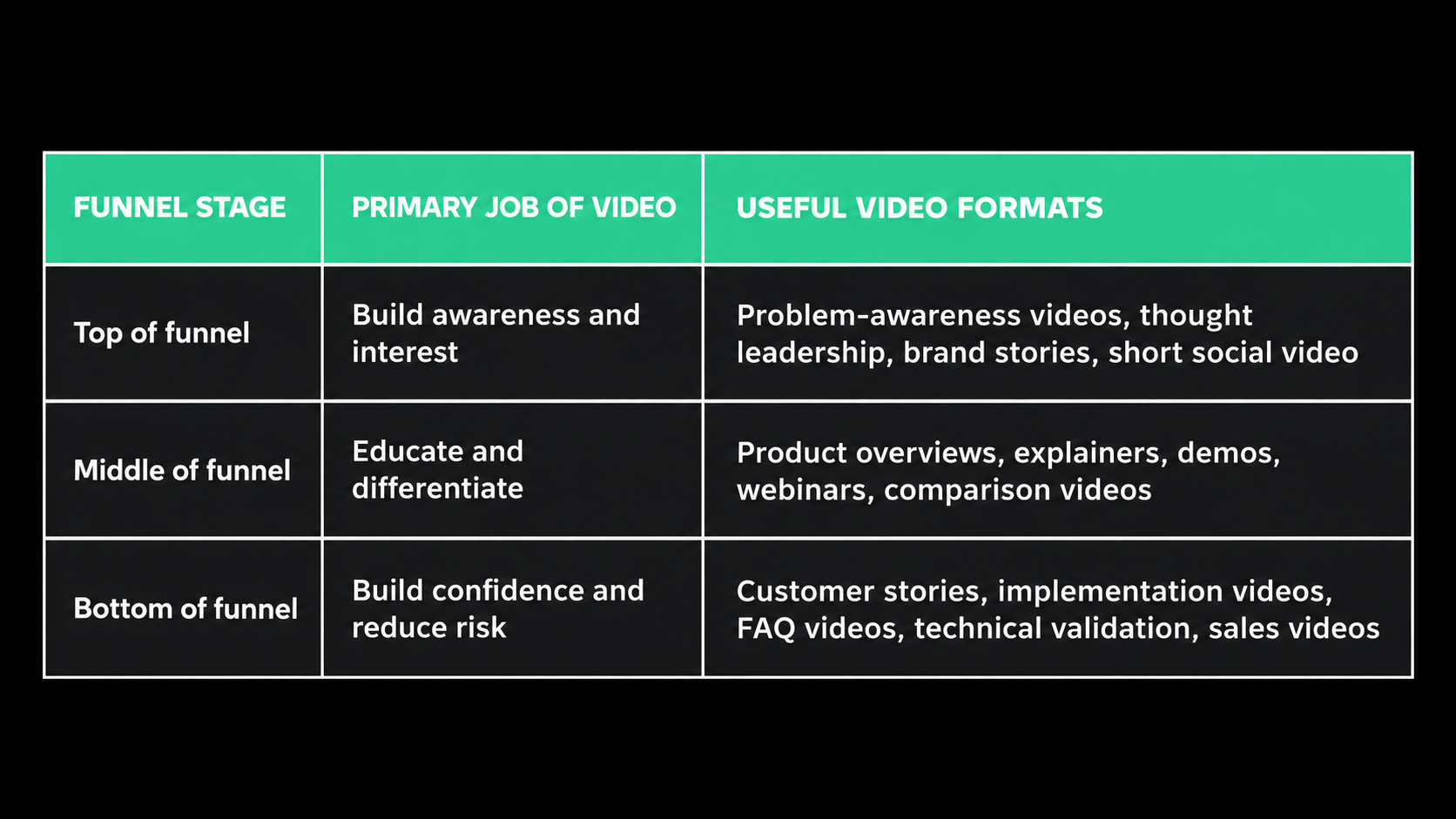
The important part is not the labels. A buyer might watch a product demo before a thought-leadership video or discover your company through a customer story.
The funnel is useful because it forces your team to define the job each video needs to perform.
Recent research supports the need for a more deliberate approach. Wistia's 2026 State of Video Report analyzed more than 13 million videos and 79 million hours of viewing data. It found that educational videos, product videos, social videos, and webinars are among the formats marketing teams are prioritizing. It also found that 8 in 10 B2B teams surveyed identify LinkedIn as their primary channel for sharing video.
The opportunity is clear. The challenge is connecting those formats rather than treating them as unrelated production projects.
Top-of-Funnel Videos: Build Awareness Before Selling
At the top of the funnel, most viewers are not ready for a product demonstration or sales conversation.
Some may not know your company. Others may not even realize the problem you solve should be a priority.
Your videos should help them recognize an issue, understand a new idea, or see their situation differently.
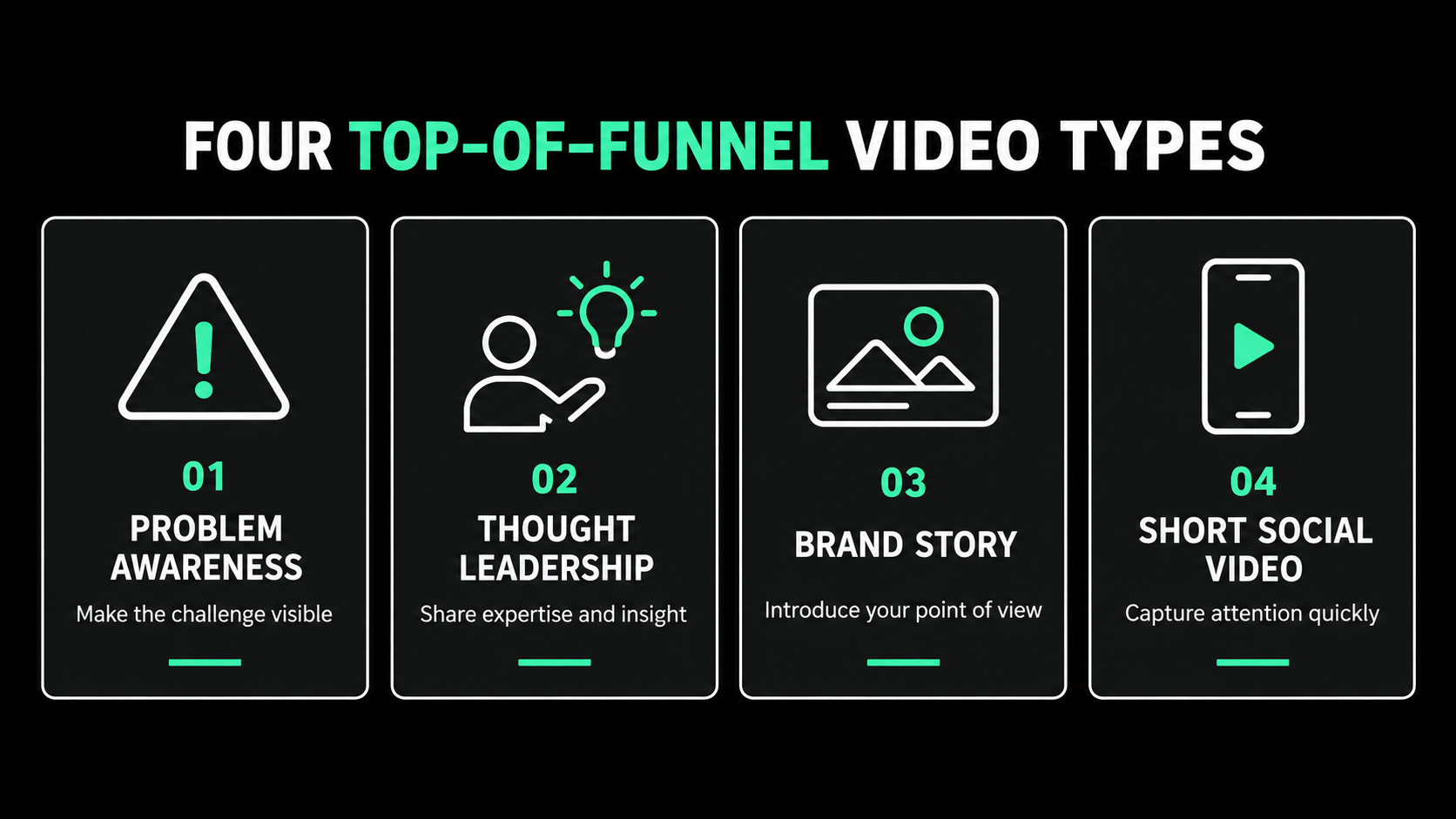
1. Problem-Awareness Videos
Problem-awareness videos describe a challenge your target buyers already experience.
For example, a cybersecurity company might create a 45-second video explaining why employee access often remains active after role changes. A manufacturing software company could show the operational problems created when production data lives across disconnected spreadsheets.
The product does not need to appear immediately.
A useful structure is:
Problem → consequence → better way to think about it
This gives buyers a reason to continue learning without asking them to evaluate a solution too early.
2. Thought-Leadership Videos
Thought leadership is useful when buyers need help interpreting a change in their market.
Subject matter experts can discuss regulatory changes, operational trends, new technologies, customer behavior, or common misconceptions.
These videos work best when the speaker actually has something specific to say. Avoid turning a generic blog summary into a talking-head video.
One strong interview can also become several shorter clips for LinkedIn, email, landing pages, and sales outreach.
3. Brand Story Videos
A B2B brand video should explain more than who you are.
It should help a potential buyer understand what your company believes, which problem you care about solving, and why your approach is different.
The strongest brand stories create context for future product conversations rather than attempting to explain every service or feature.
4. Short Social Videos
Short videos give B2B companies a practical way to test messages.
Turn one useful idea into a 20 to 60-second video with a strong opening, one clear point, captions, and a simple next step.
LinkedIn research based on more than 13,000 B2B video ads found that creative execution can have a major effect on performance. Its analysis found that shorter, more human and intentionally structured formats can improve video completion and engagement compared with generic executions.
For top-of-funnel video, attention is valuable, but relevance is better. Reaching 2,000 people who fit your market can matter more than reaching 100,000 people who never will.
Middle-of-Funnel Videos: Help Buyers Understand the Solution
Once someone knows the problem, their questions change.
How does your solution work? Is it relevant to our situation? How is it different? Can my team actually use it?
This is where your B2B video strategy should shift from awareness toward education.
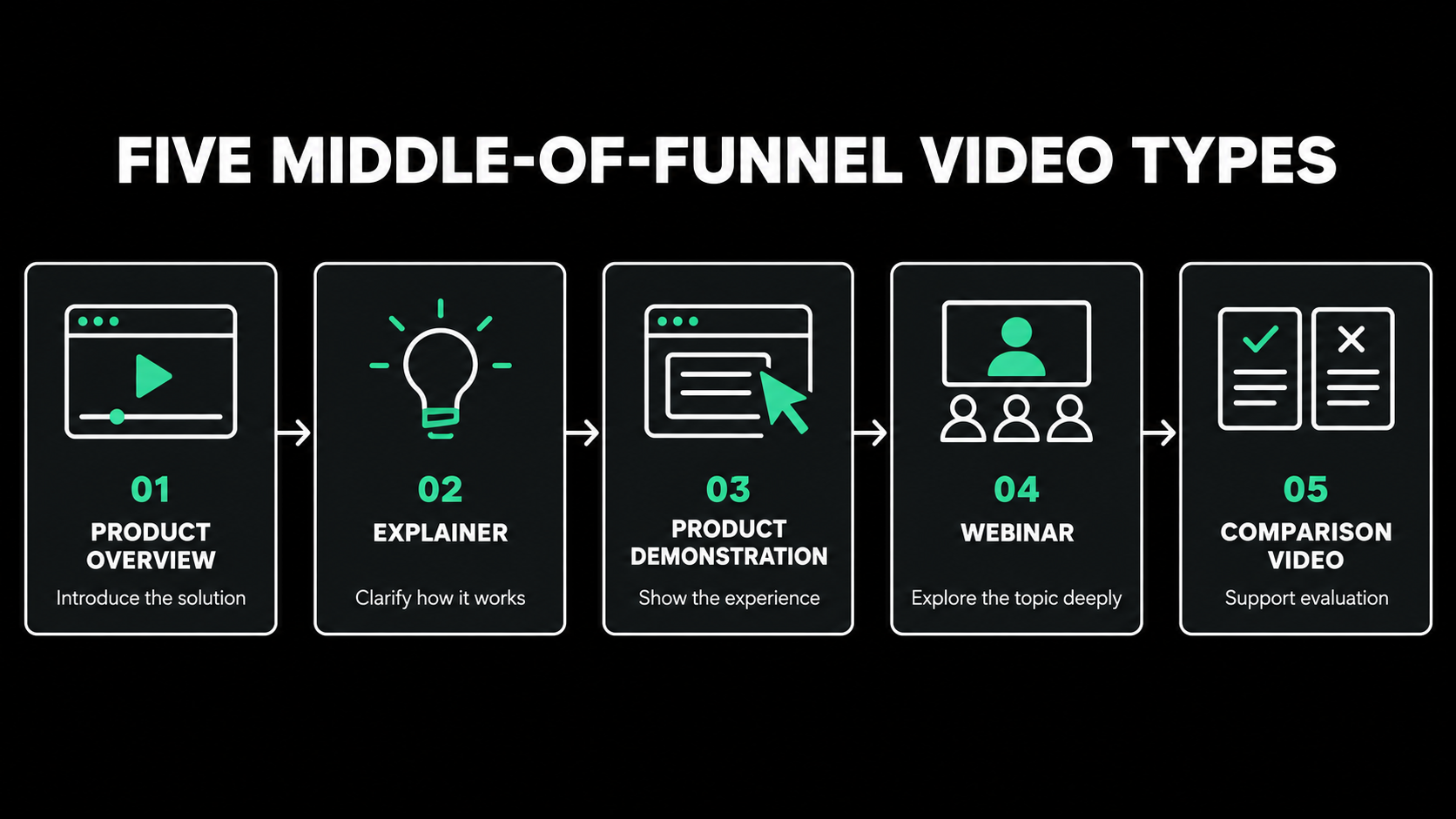
1. Product Overview Videos
A product overview explains what your solution does, who it is designed for, and the major value it provides.
It should not become a tour of every button in the interface.
For a complex SaaS product, for example, a two-minute overview might show the core workflow:
Problem → platform → key workflow → outcome → next step
This creates enough understanding for someone to decide whether a deeper demonstration is worthwhile.
2. Explainer Videos
Explainers work well when the product, service, process, or business model is difficult to understand quickly.
Animation, interface demonstrations, diagrams, motion graphics, or a combination of these can simplify technical concepts without removing the substance.
Good explainers answer a specific question.
“What does our platform do?” is better than trying to explain your entire company, market, technology stack, and competitive advantage in one video.
3. Product Demonstrations
Buyers further into their research usually want evidence.
Show the product doing the job.
For software, demonstrate a realistic workflow rather than clicking through menus. For equipment or physical products, show the product operating under conditions the target customer recognizes.
The viewer should finish the demonstration understanding what using the product would actually look like.
4. Webinars and Expert Sessions
Webinars are useful when the subject requires more depth.
Wistia's 2026 research found webinars were the second most impactful video format among the teams surveyed, and recorded webinars can continue attracting viewers for months after the live session.
That makes them useful beyond lead generation.
A 30-minute webinar might become a five-minute summary, three expert clips, six social posts, an email sequence, and material for a blog article.
5. Comparison and Evaluation Videos
Buyers compare alternatives whether brands participate in that conversation or not.
Help them evaluate intelligently.
Instead of producing a video claiming your solution is better than every alternative, explain the criteria buyers should examine. That could include implementation, integrations, security, reporting, support, scalability, or total cost.
This approach is more credible and more useful.
Bottom-of-Funnel Videos: Provide Proof and Reduce Risk
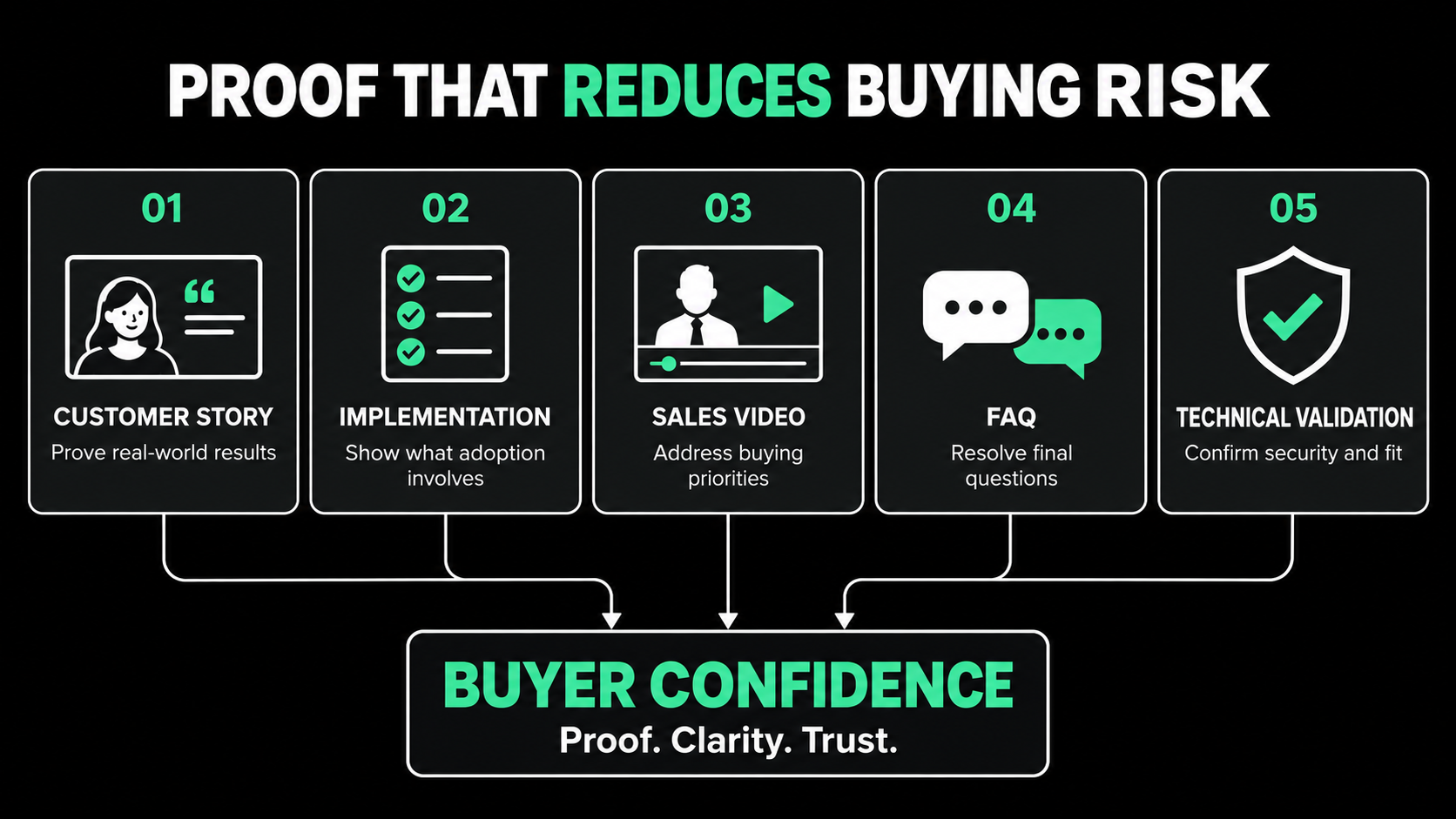
Near the bottom of the funnel, buyers usually do not need another broad introduction.
They need confidence.
Their questions are often practical:
Will this work for a company like ours? What will implementation involve? Can our technical team approve it? What happens if something goes wrong?
Bottom-of-funnel B2B video content marketing should address those questions directly.
1. Customer Stories
A useful customer story has a simple structure:
Situation → challenge → decision → experience → result
Focus on the customer's perspective instead of turning the entire video into praise for your company.
Specific operational details make the story believable.
Never manufacture results or ask customers to repeat scripted claims they would not naturally make.
2. Implementation Videos
Implementation risk can slow B2B decisions.
A short video explaining onboarding, migration, integration, timelines, responsibilities, or support can remove uncertainty before it becomes an objection.
This is especially useful for software, enterprise services, manufacturing systems, and other products that require internal coordination.
3. Sales Enablement Videos
Not every video needs to live publicly on your website.
Sales teams can use short videos to answer recurring questions, introduce technical specialists, summarize proposals, or explain part of the solution after a meeting.
A reusable two-minute video can be more consistent and easier to understand than repeatedly explaining the same complex topic through email.
4. FAQ and Objection-Handling Videos
Ask sales which questions appear in nearly every late-stage opportunity.
Those questions should probably become videos.
Topics might include pricing structure, security, implementation, integrations, customer support, customization, or contract terms.
Keep each video focused on one question so salespeople can send exactly what a prospect needs.
5. Technical Validation Videos
Complex purchases often include people who were not involved when your company first entered the conversation.
IT, operations, finance, procurement, security, and senior leadership may all require different information.
Technical validation videos can explain architecture, integrations, compliance processes, testing, manufacturing standards, or other details needed for internal approval.
At this stage, clarity is usually more valuable than polished brand language.
One Video Should Become More Than One Asset
One of the most inefficient approaches to B2B video marketing strategy is producing a video, publishing it once, and immediately beginning another production.
Start thinking in content systems.
Imagine recording a 30-minute conversation with one of your company's subject matter experts.
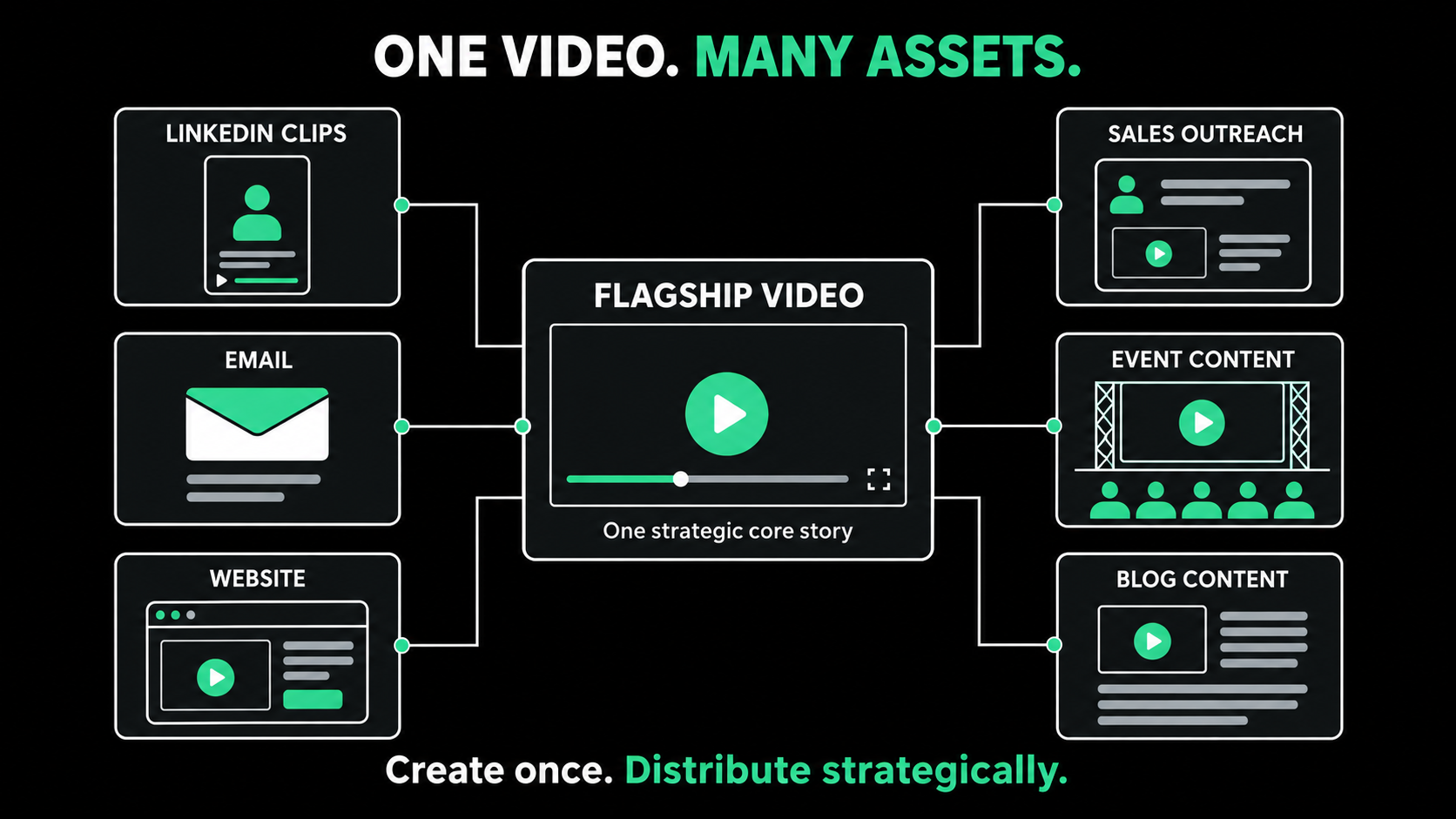
That session might produce:
- One long-form educational video
- One three-minute overview
- Five short social clips
- A sales follow-up video
- GIFs or short clips for landing pages
- Quotes and insights for a blog
- Content for an email campaign
- Material for an event presentation
The idea is not to repeat the exact same content everywhere.
Adapt the original material to match the context of each channel.
This approach is particularly useful for B2B marketing teams with limited internal production capacity. It also gives the initial concept more opportunities to create value.
How Should B2B Videos Be Distributed Across the Funnel?
Distribution should be planned before production.
For top-of-funnel videos, prioritize channels where prospects discover ideas: LinkedIn, YouTube, paid social, industry publications, events, and organic social.
For middle-of-funnel content, focus on your website, product pages, email nurture campaigns, retargeting, webinars, resource centers, and sales follow-up.
For bottom-of-funnel videos, think about customer-story pages, demo follow-ups, proposal sequences, sales outreach, onboarding pages, and stakeholder-specific communication.
A video designed for a homepage may need a different opening, length, and CTA than one designed for a salesperson to send after a discovery call.
That is why distribution cannot be an afterthought.
How Should You Measure B2B Video Marketing?
Views alone rarely tell you whether a B2B video is doing its job.
Measurement should match the funnel stage.
For awareness videos, look at qualified reach, video engagement, watch time, profile visits, branded search, and traffic from relevant audiences.
For consideration videos, look at engagement, product-page visits, repeat visits, webinar registrations, content downloads, and other progression signals.
For decision-stage videos, look at demo requests, influenced opportunities, sales usage, conversion assists, and whether videos help answer questions that previously slowed deals.
Wistia's 2026 data reinforces the difference between attention and action. Shorter videos generally achieve higher engagement rates, while longer videos can attract highly invested viewers who are more likely to take an action.
The lesson is not that every video should be short or long.
Length should follow intent.
How to Decide What B2B Videos to Create First
Do not begin by creating one of every format.
Start by finding the biggest gap in your buyer journey.
If buyers do not understand why the problem matters, prioritize awareness and educational video.
If prospects understand the problem but struggle to understand your product, build a product overview or explainer.
If opportunities reach sales but stall because stakeholders want evidence, prioritize customer stories, demonstrations, FAQs, and implementation content.
Content Marketing Institute's 2026 B2B research found that effective marketing teams most often credited content relevance and quality, followed by team skills and capabilities, for improving performance.
That is a useful reminder when planning video.
Producing ten average videos is not automatically a stronger strategy than producing three highly relevant ones that answer important buyer questions.
When Does It Make Sense to Work With a B2B Video Agency?
Not every video requires an outside production partner.
Internal teams can often handle quick expert videos, screen recordings, event clips, and regular social content effectively.
An agency becomes more useful when the video carries greater strategic or production weight, such as a product launch, customer story program, flagship brand video, animation-heavy explainer, campaign creative, or full-funnel video system.
The important question is not simply whether to outsource production.
Ask whether your team has the strategy, creative direction, production capacity, and post-production resources to create the asset properly and adapt it for every place it needs to work.
Spacebar Visuals has worked with more than 100 companies, including ISO, Rho, and Cloaked. Across B2B projects, one pattern is consistent: deciding what the video needs to accomplish before cameras, animation, or editing begin makes the production process much more useful.
Planning your next B2B video?
Spacebar Visuals helps B2B teams turn marketing goals, buyer questions, and complex products into video strategies built for the full funnel.
BOOK A CALL to discuss what your next video should accomplish.
Let’s build your product story together


View Related Resources

Product Demo Video vs. Explainer Video
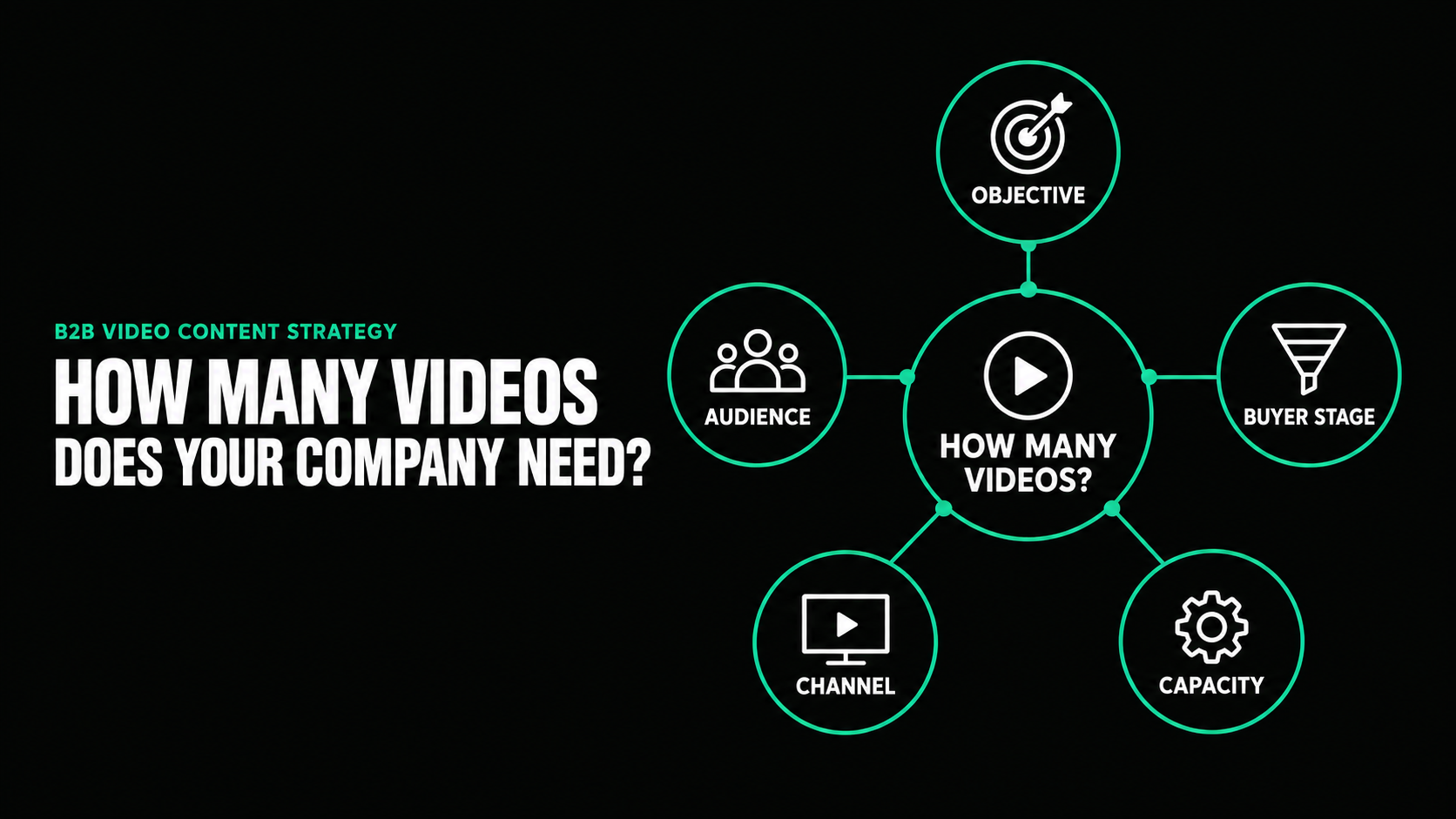
How Many Videos Does Your B2B Company Actually Need?
.png)