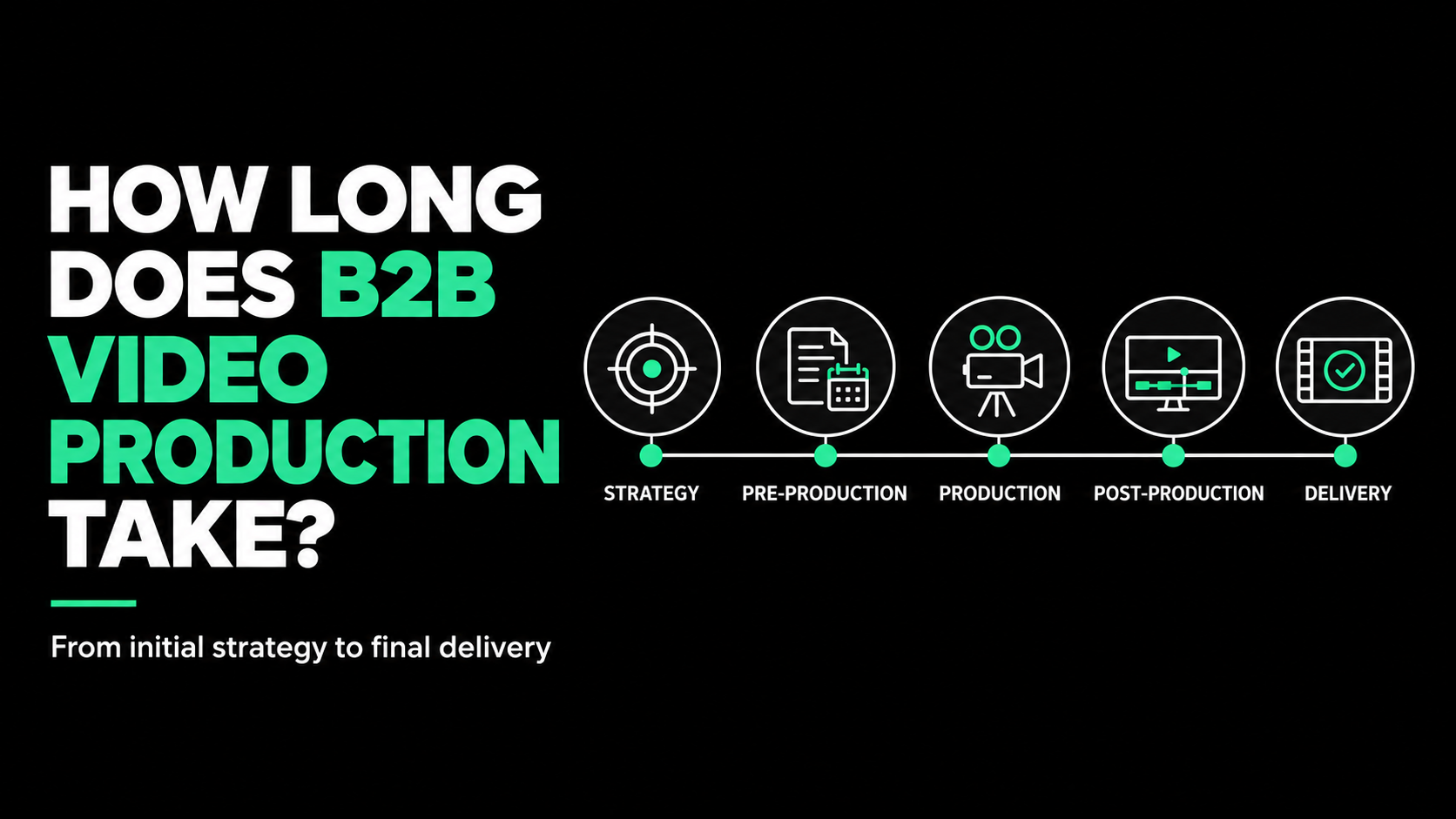
How Many Videos Does Your B2B Company Actually Need?

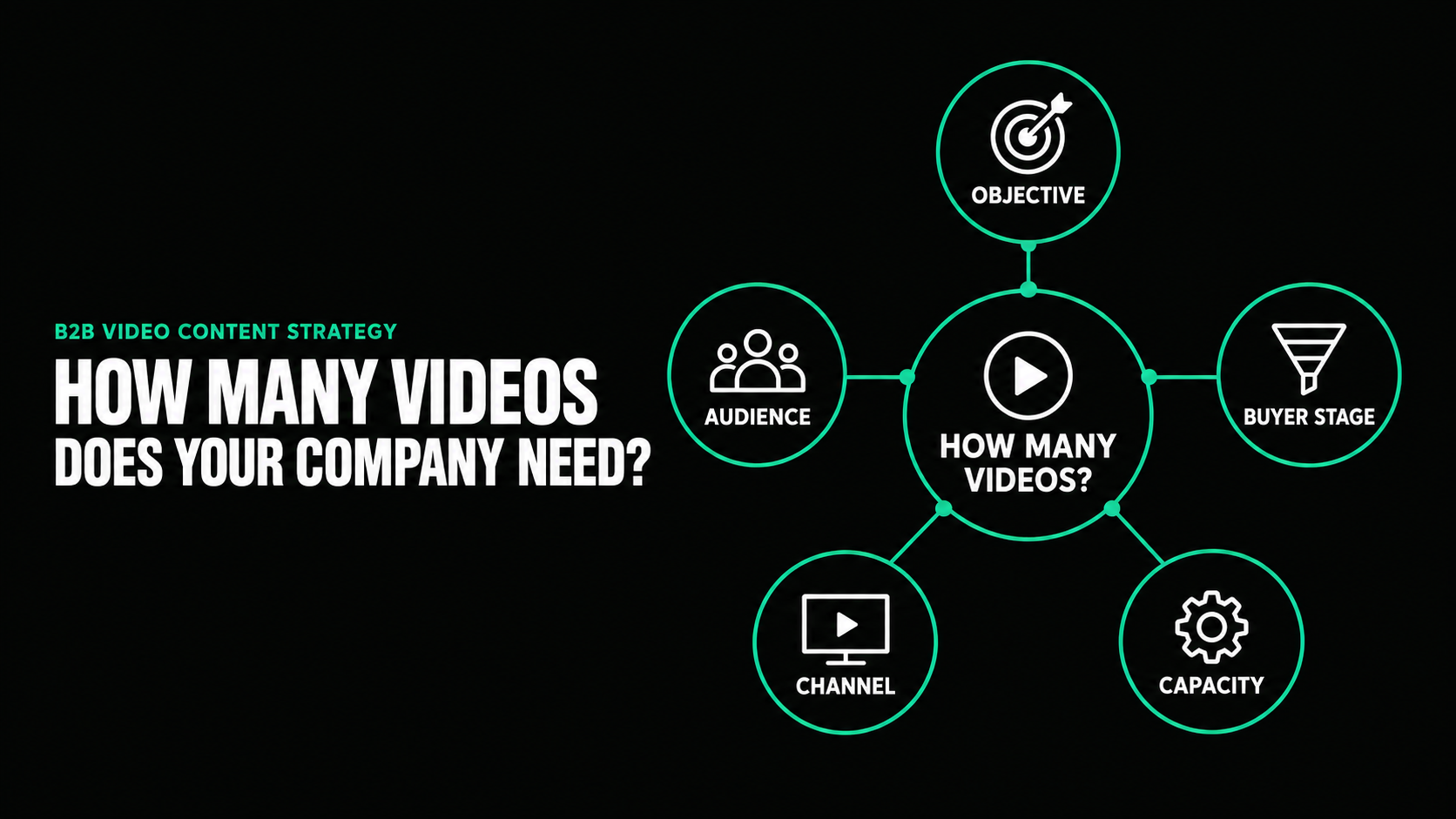
B2B Video Content Strategy: How Many Videos Do You Need?
Most B2B companies do not need to publish a new video every week. They need enough videos to cover their priority audiences, key buyer questions, major campaigns, and core sales needs. For many teams, that means starting with three to six strategic video concepts per quarter, then turning each concept into several channel-specific assets.
The exact number depends on your objectives, product complexity, distribution plan, and internal capacity.
A strong B2B video content strategy is not a production quota. It is a plan for creating the smallest useful set of videos that supports the buyer journey and can be distributed consistently.
Why “How Many Videos?” Is the Wrong First Question
Starting with a monthly number encourages teams to fill a calendar instead of solving marketing problems.
Ten disconnected videos are not necessarily more valuable than three concepts that address real buyer questions and support several channels.
Ask these questions first:
- What business goals must video support?
- Which audiences are the priority?
- What questions or objections slow the buyer journey?
- Where will buyers encounter the content?
- What can the team distribute and measure properly?
The answers determine the right volume.
Start With the Business Jobs Video Must Perform
List the specific jobs that video should handle during the next quarter or half-year.
Common jobs include:
- Introduce the company or a new category
- Explain a complex product or service
- Support a launch or demand-generation campaign
- Give buyers credible customer proof
- Help sales answer repeated questions
- Prepare prospects for a demonstration
- Promote an event or webinar
- Educate customers about onboarding or features
- Establish executive or subject-matter expertise
A customer interview can become a case study, proof-point clips, sales content, and material for a written story.
Build the plan around business jobs, then decide how many concepts are required to complete them.
Map Video Needs Across the Buyer Journey
A useful B2B video marketing strategy supports buyers at different stages.
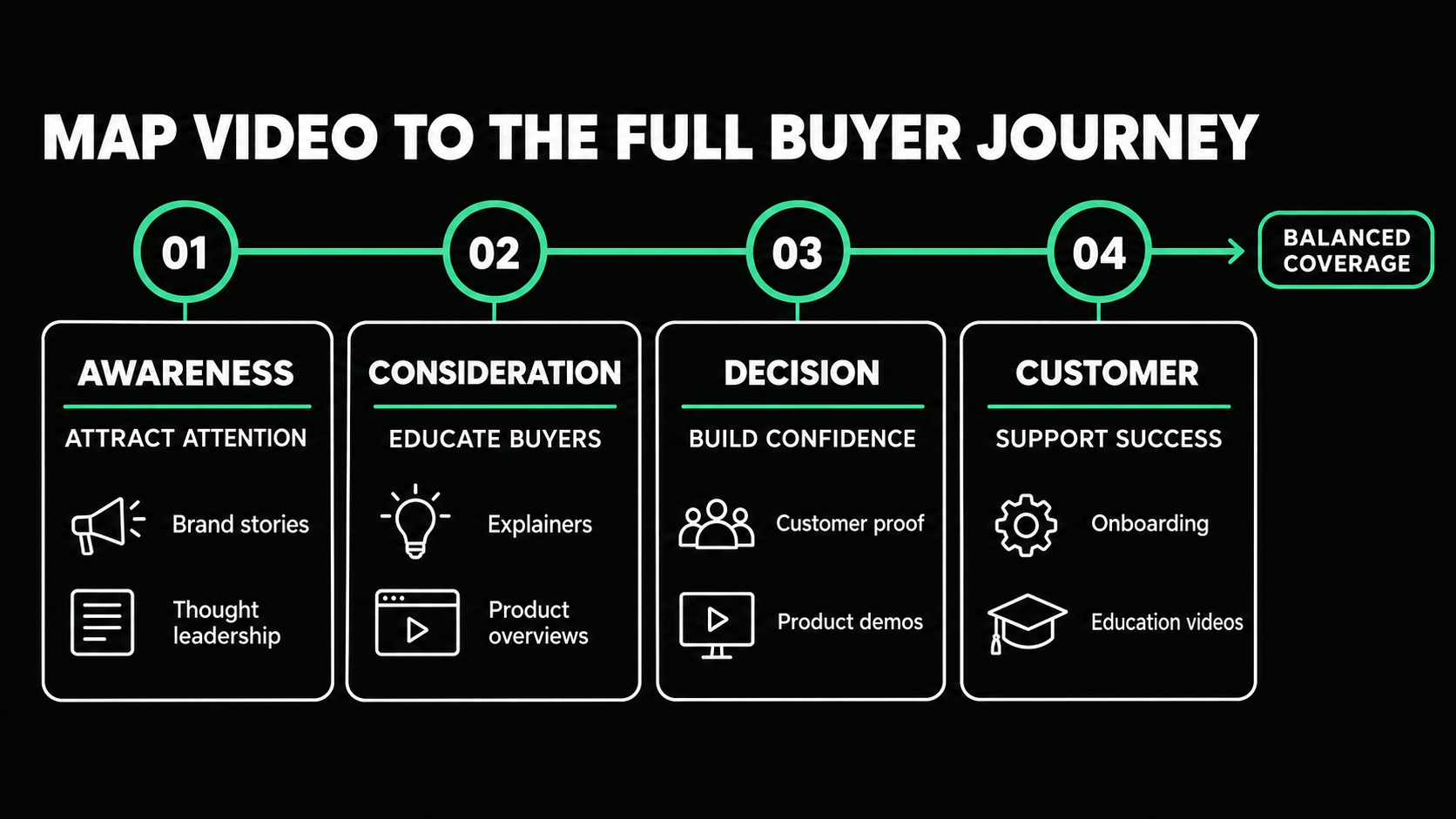
Top of funnel: Create relevance
Top-of-funnel videos should help the right audience recognize a problem, understand a new idea, or become familiar with the company.
Useful formats include:
- Short problem-led campaign videos
- Executive insights
- Educational clips
- Event promotions
- Brand or category stories
Start with one or two concepts connected to the quarter’s main campaign or market message.
Middle of funnel: Explain and differentiate
Buyers at this stage want to understand the product, approach, and difference from other options.
Useful formats include:
- Product overview videos
- Animated explainers
- Use-case videos
- Webinar clips
- Expert interviews
- Process or methodology videos
Prioritize the workflows and objections that appear most often in qualified sales conversations.
Bottom of funnel: Reduce risk
Late-stage buyers need proof, specificity, and confidence.
Useful formats include:
- Customer stories
- Product demonstrations
- Implementation explainers
- Security or integration videos
- Leadership messages
- Personalized sales videos
A focused video that answers a serious objection can be more valuable than several general social clips.
Customer stage: Improve adoption
After the sale, use video for onboarding, feature education, and training when demonstration or visual context improves understanding.
Calculate the Minimum Useful Video Library
Instead of choosing an arbitrary publishing frequency, build a simple coverage matrix.
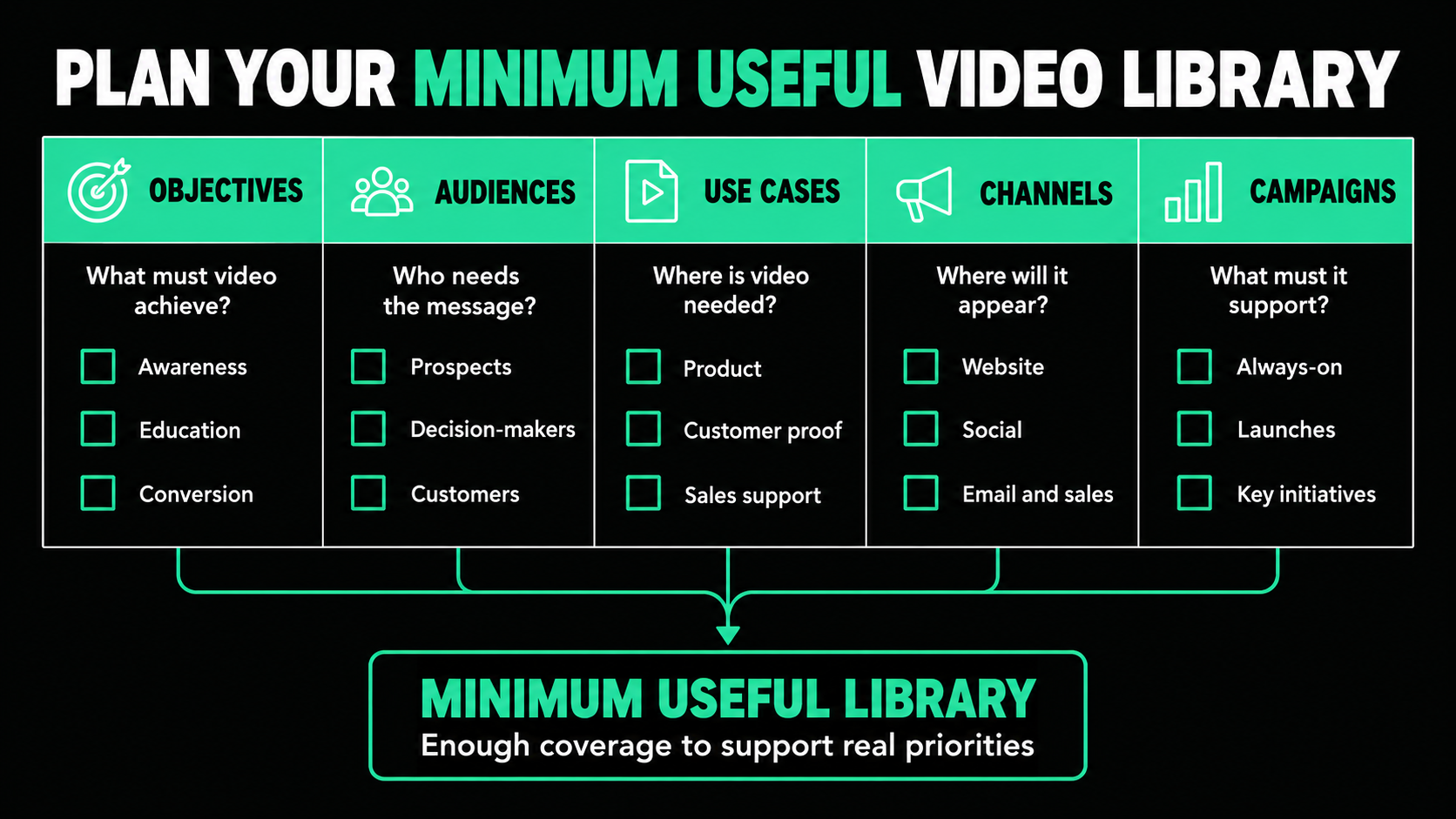
Suppose a SaaS company has one product launch, two priority use cases, and one major customer story planned for the quarter. It may need four core concepts:
- A product-launch overview
- A use-case video for operations leaders
- A use-case video for finance leaders
- A customer proof story
Those concepts could produce 15 deliverables through paid cutdowns, vertical edits, sales clips, captioned versions, and still frames. They remain four strategic ideas with multiple uses.
Use a Core, Campaign, and Continuous Model
A practical video content strategy can be organized into three layers.
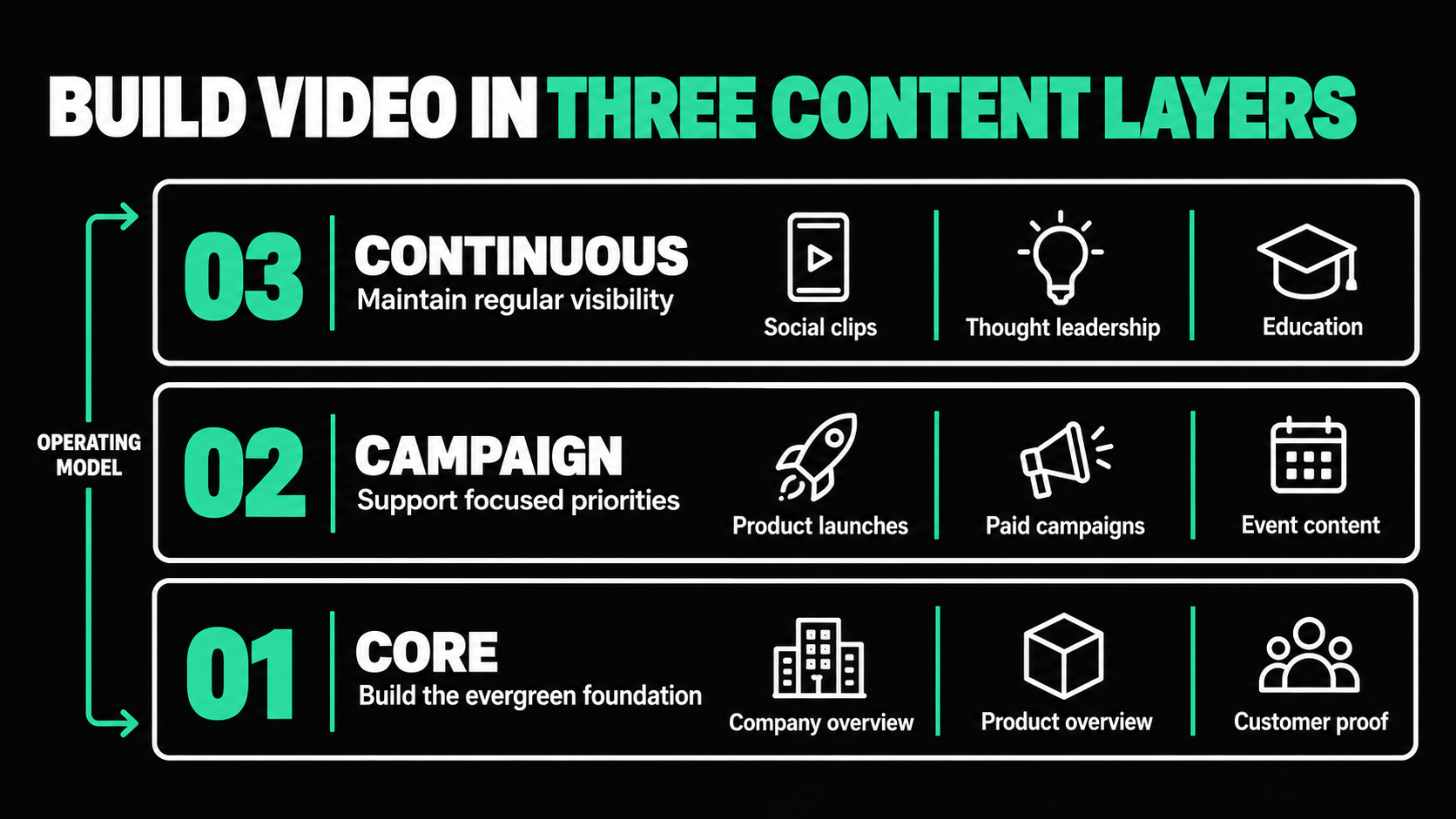
Core videos
Core videos explain the company, product, customer value, and strongest proof. Examples include a homepage overview, product explainer, or flagship customer story.
Campaign videos
Campaign videos support launches, demand-generation programs, events, or priority messages. A quarterly plan might include two or three concepts adapted across channels.
Continuous videos
Continuous content answers ongoing questions through expert clips, product tips, sales messages, and webinar excerpts. Use repeatable formats, such as one monthly recording session that generates several short pieces.
This model protects quality while keeping output realistic.
Plan Concepts and Deliverables Separately
Teams often confuse the number of ideas with the number of final files.
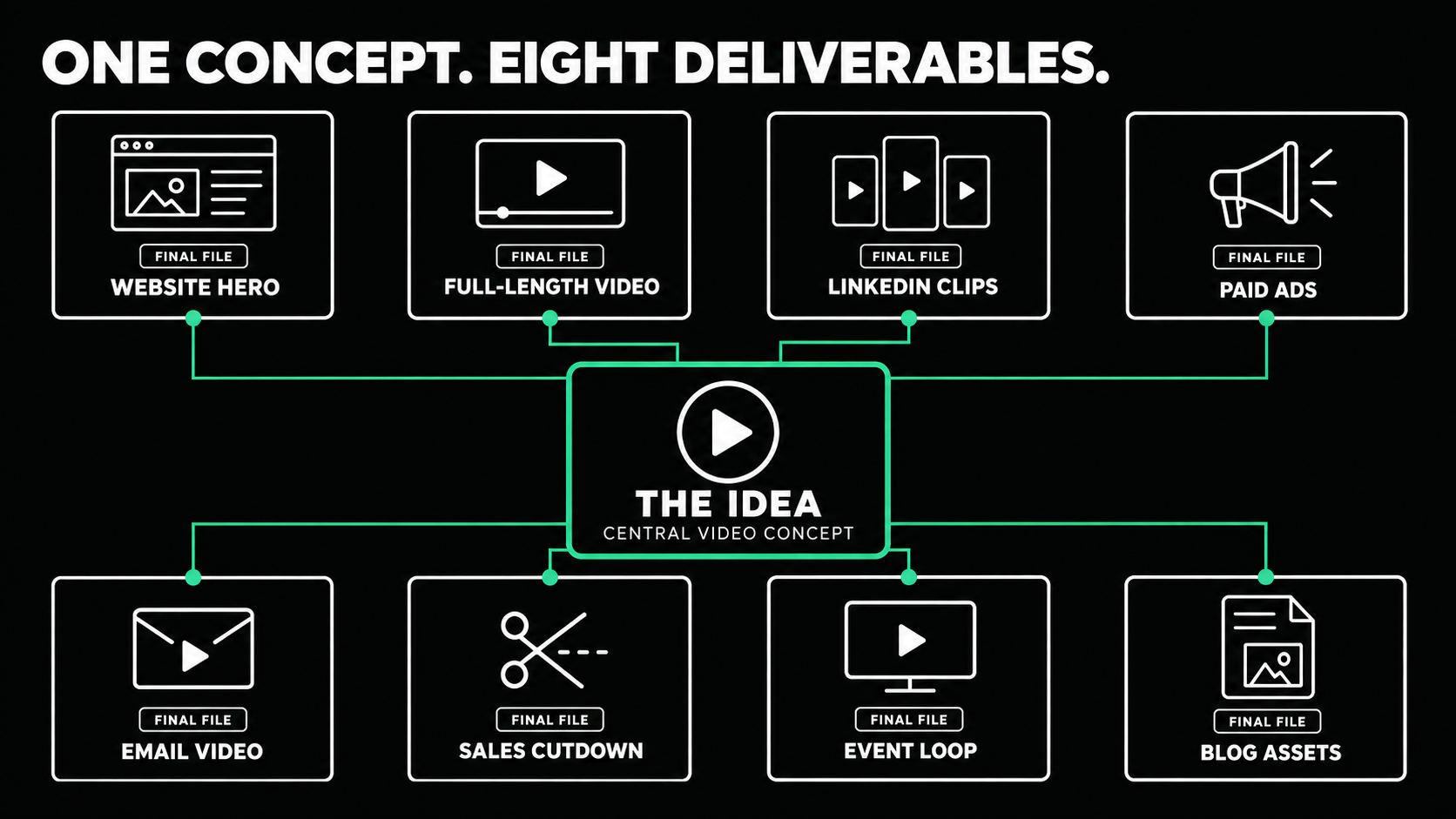
A concept is the main story or creative idea. A deliverable is a version prepared for a specific channel, audience, length, or format.
One product video concept might produce:
- A 90-second website video
- A 30-second paid ad
- Three 15-second feature clips
- A vertical social version
- A silent event-screen edit
- A clip for sales presentations
- A GIF for email
- Still images for campaign creative
The answer may be “four concepts and 20 deliverables.” This distinction prevents unnecessary standalone productions.
Plan repurposing before production so the team captures alternate openings, shorter answers, vertical framing, and different calls to action.
Match the Plan to Production Capacity
The strategy must be sustainable for the people handling approvals, production, publishing, and reporting.
Review these constraints:
- Available budget
- Internal subject-matter expert time
- Number of reviewers
- Legal or compliance requirements
- Production and editing capacity
- Channel management capacity
- Paid distribution budget
- Measurement tools and reporting time
If your team can distribute and measure only two concepts well, producing six may create a backlog rather than results.
A Practical Starting Plan for B2B Companies
For a company building its first structured B2B video strategy, a useful six-month starting plan might include:
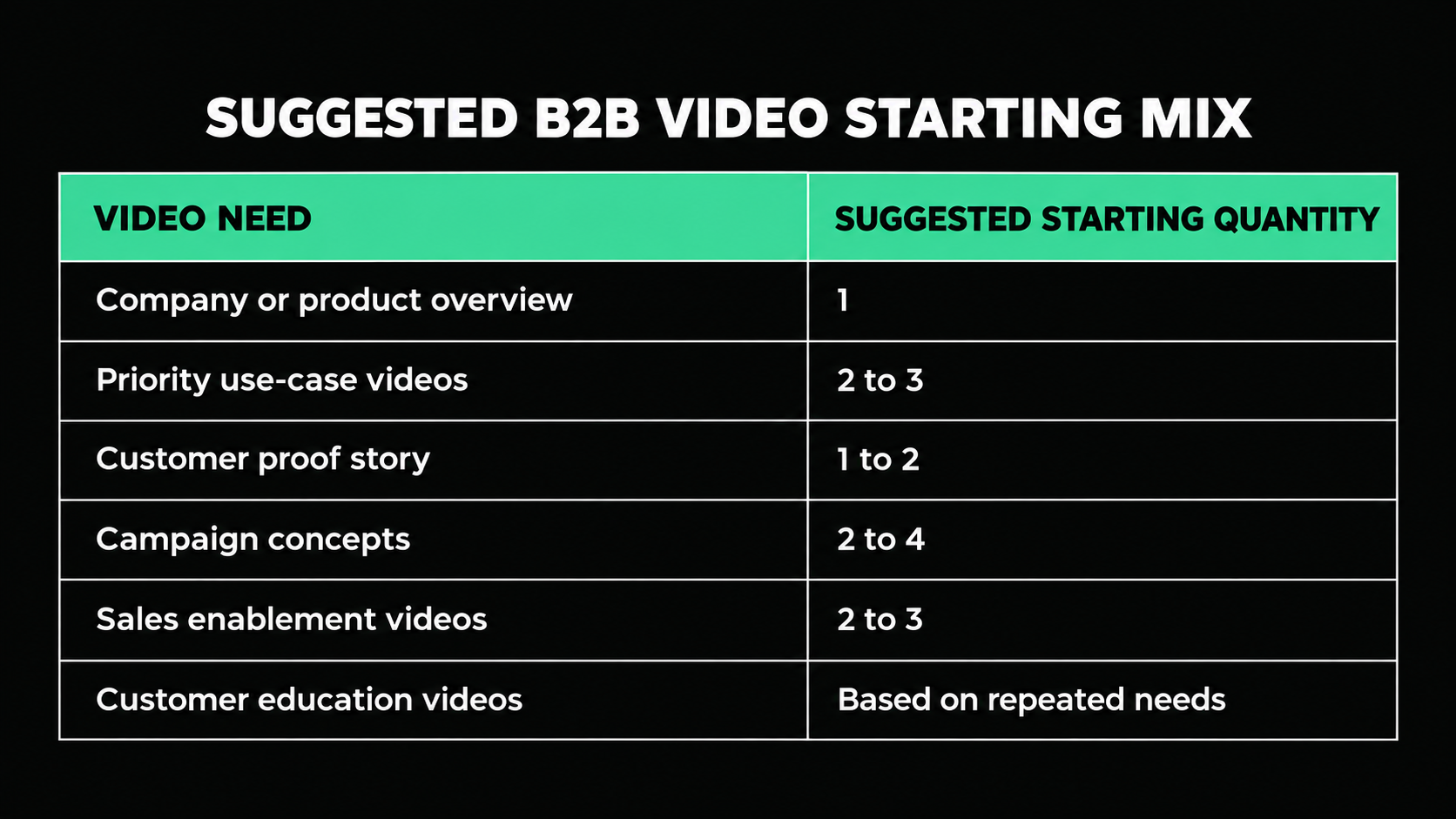
This is a planning baseline, not a production requirement. A consultancy may need more expert content, while a technical SaaS company may need more product education.
The better rule is to cover the most important buyer questions before increasing publishing frequency.
How to Prioritize the Next Video

When several requests compete for budget, score each idea against five criteria:
- Business importance: Does it support an active priority?
- Audience need: Is there evidence that buyers need this information?
- Distribution: Are there clear channels and campaign owners?
- Reuse potential: Can the concept create several useful assets?
- Measurement: Can the team identify a meaningful outcome?
Prioritize ideas with a clear audience, important job, committed distribution, and several uses.
Measure Whether You Need More Content
Do not increase volume until you understand how the current library performs.
Review:
- Which videos are actually used by marketing and sales
- Which topics generate qualified engagement
- Where viewers stop watching
- Which assets influence conversions or opportunities
- Which buyer questions remain unanswered
- Which videos have become outdated
Google Analytics can track starts, progress milestones, and completions for embedded YouTube videos. Combine that data with conversions, CRM activity, and sales feedback. Google Analytics enhanced measurement documentation
Wistia’s 2026 research analyzed more than 13 million videos and found that shorter videos generally earn higher engagement, while longer videos can create more total watch time. Evaluate length and completion against the asset’s purpose. Wistia 2026 State of Video Report
Create more when there is a documented gap or an opportunity to scale a proven topic.
Build a System, Not a Video Quota
So, how many videos does your B2B company actually need?
Enough to cover the highest-priority objectives, audiences, buyer questions, and channels without exceeding the team’s ability to produce, distribute, and measure them properly.
For many companies, three to six concepts per quarter is a sensible starting point. Channel-specific versions may create a much larger final output.
The strongest B2B video content marketing programs do not win through volume alone. They create a connected system in which every video has a job, a viewer, a distribution plan, and a useful next action.
Not sure how many videos your company needs or which concepts should come first?
Spacebar Visuals helps B2B teams build practical video strategies for product marketing, demand generation, sales enablement, customer education, events, and brand awareness.
Book a video strategy call to identify your highest-priority video opportunities and the right production plan.
Let’s build your product story together


View Related Resources

Product Demo Video vs. Explainer Video
.png)
Animated vs Live Action Video for B2B Companies